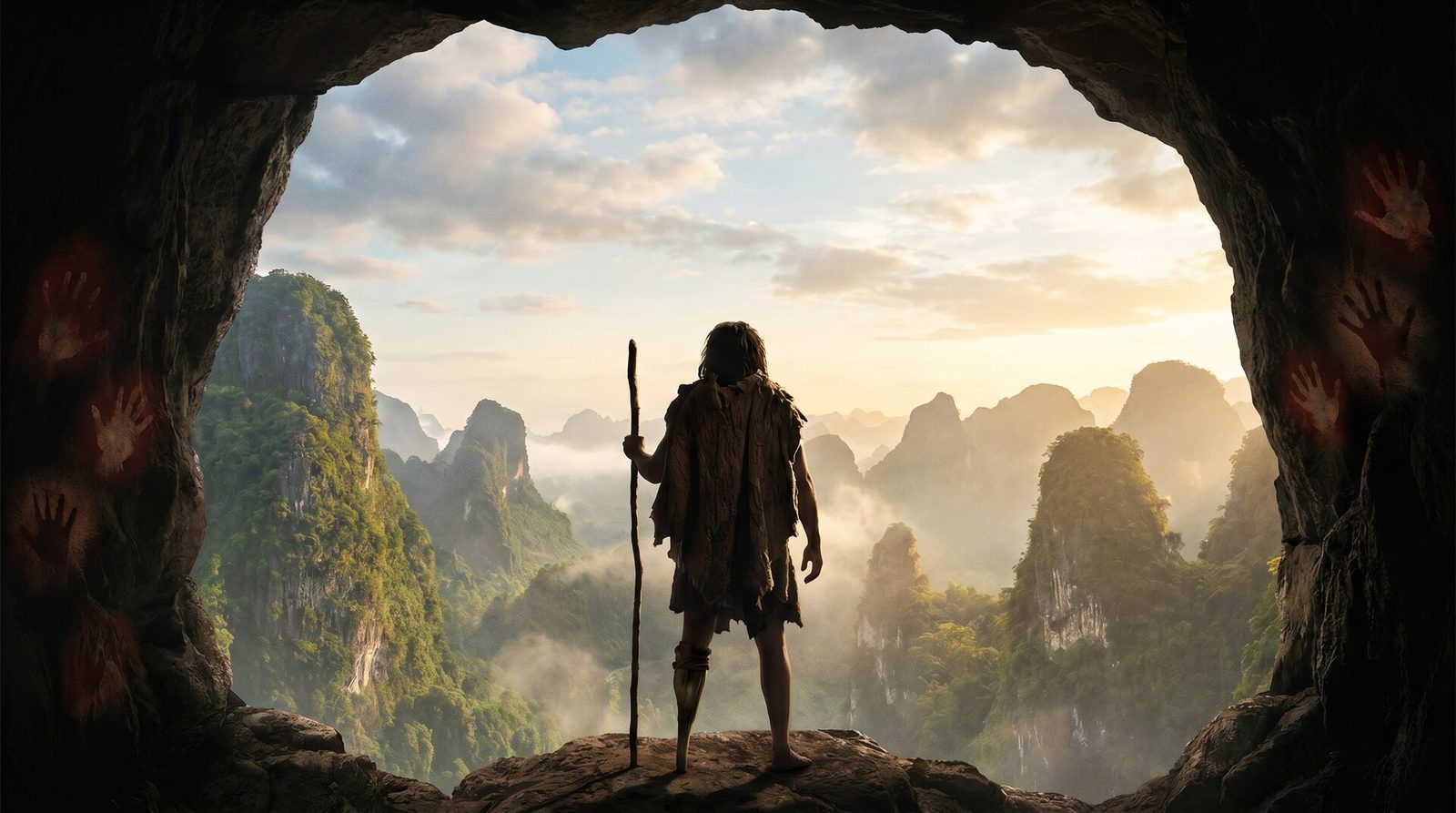
An Epic Productions film
Compassion, not conquest, as our oldest power.
A journey into our Pleistocene past, 31,000 years into the world that made us, told through a story of firsts: the first known surgery, some of the earliest art, the first burial, the first wayfinders to cross the open ocean. In their oldest choices, we begin to read what is still within us.
A narrative fiction imagined from recent archaeological evidence of the deep past, grounded in the discovery published in Nature (2022): “Surgical amputation of a limb 31,000 years ago in Borneo.”
Written with original illustrations, by Albert Lin and the TEBO 1 project team, all rights reserved.
All imagery is AI-generated concept art, created with Google Gemini 3 Pro Image (“Nano Banana Pro”) and Imagen.
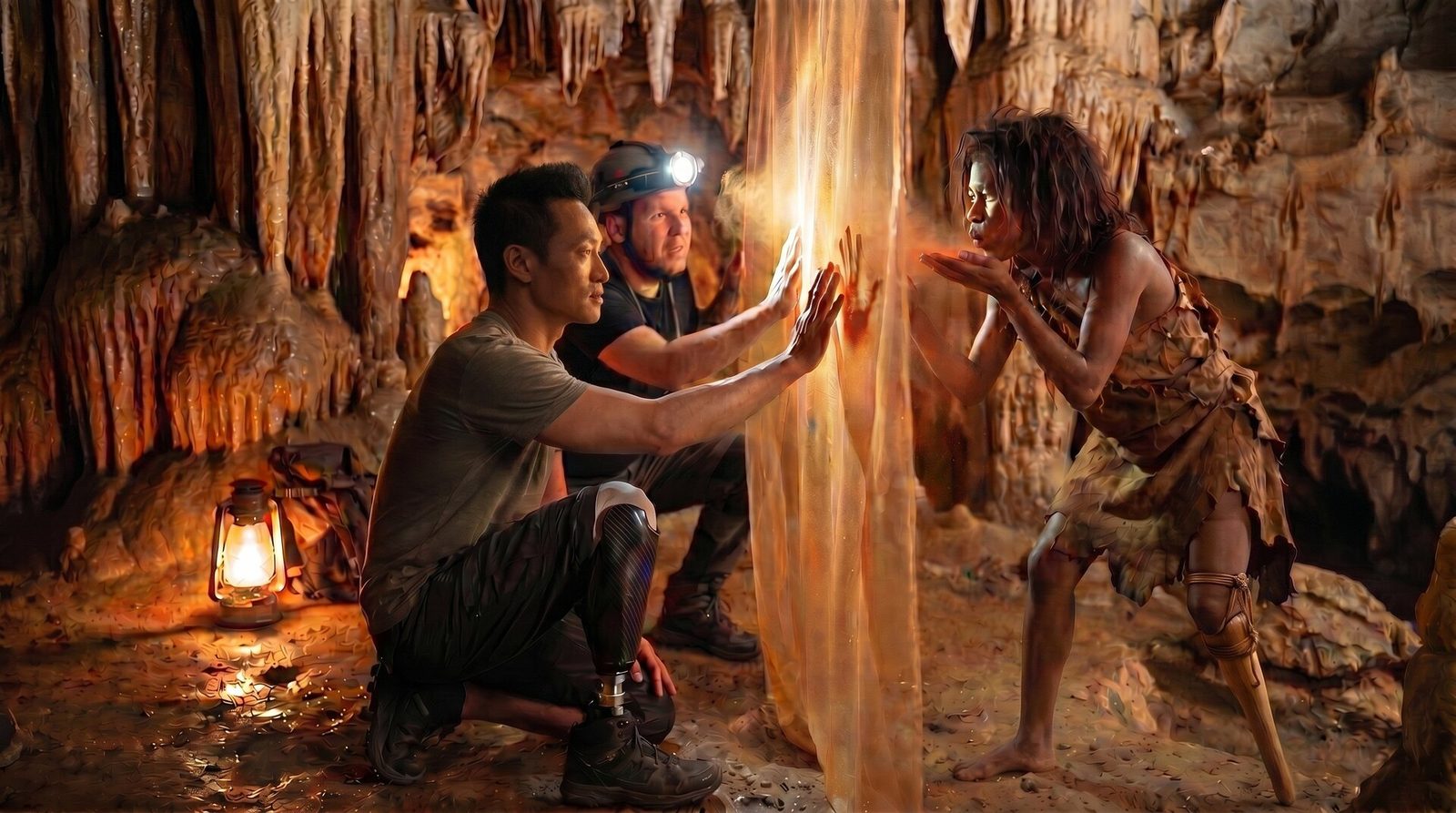
Cold open in a world uncovered only recently, deep in the Borneo karst. Prof. Maxime Aubert, the leading authority whose team made the discovery, brings explorer Dr. Albert Lin to the cave wall to see something remarkable. The two men kneel and press their hands to the stone, one an amputee, the other the son of an amputee. On the far side of a thin glowing veil, across 31,000 years, a child presses back. The whole film lives in that contact, a hand reaching across deep time. Then we step through.
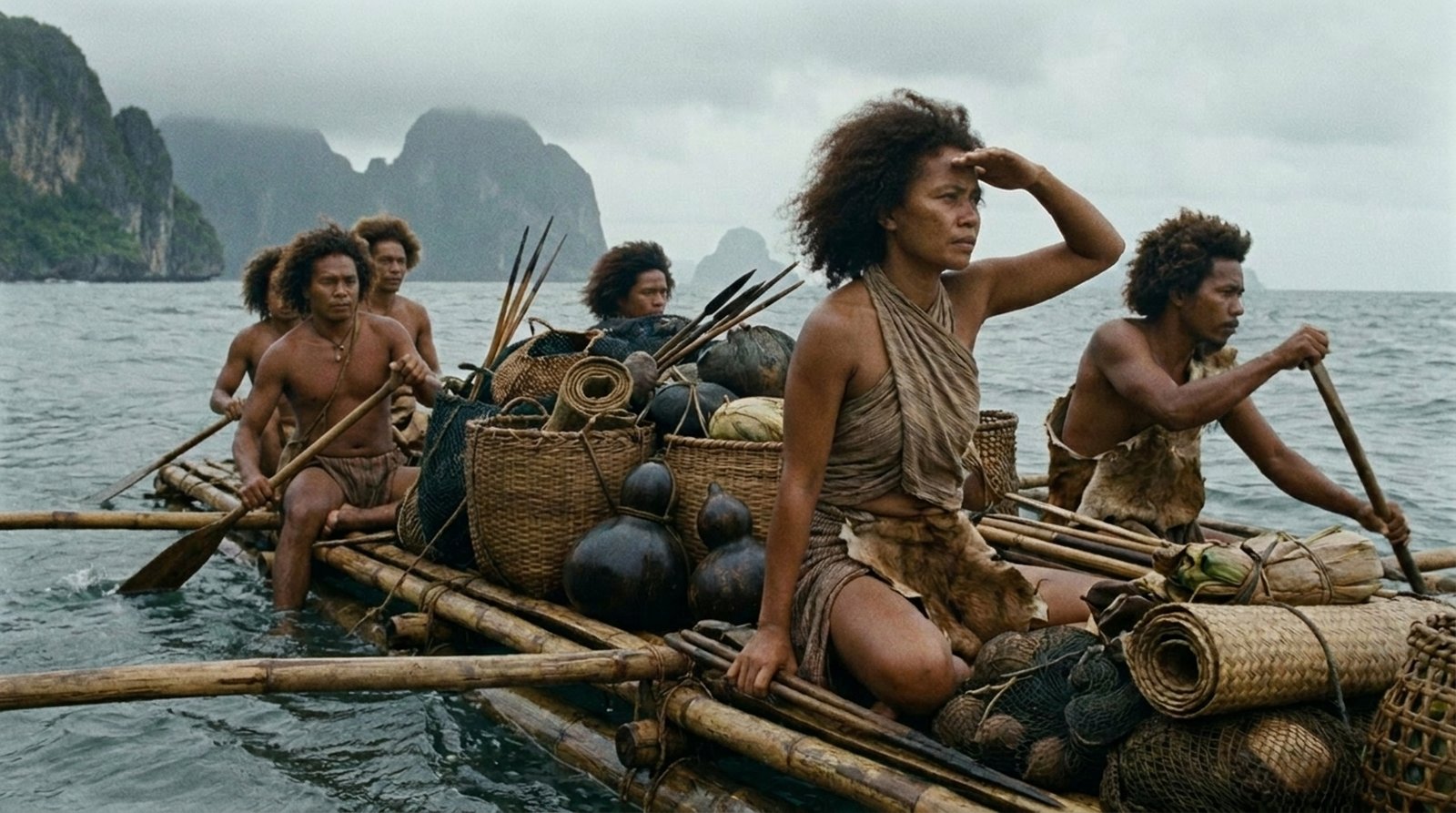
At sea on bamboo rafts, baskets and gourds lashed tight, a woman shields her eyes and reads the horizon. Among the first people to cross open ocean, paint caves, and care for their own. We enter their world, and the oldest power they carry is not the spear but the choice to keep one another.
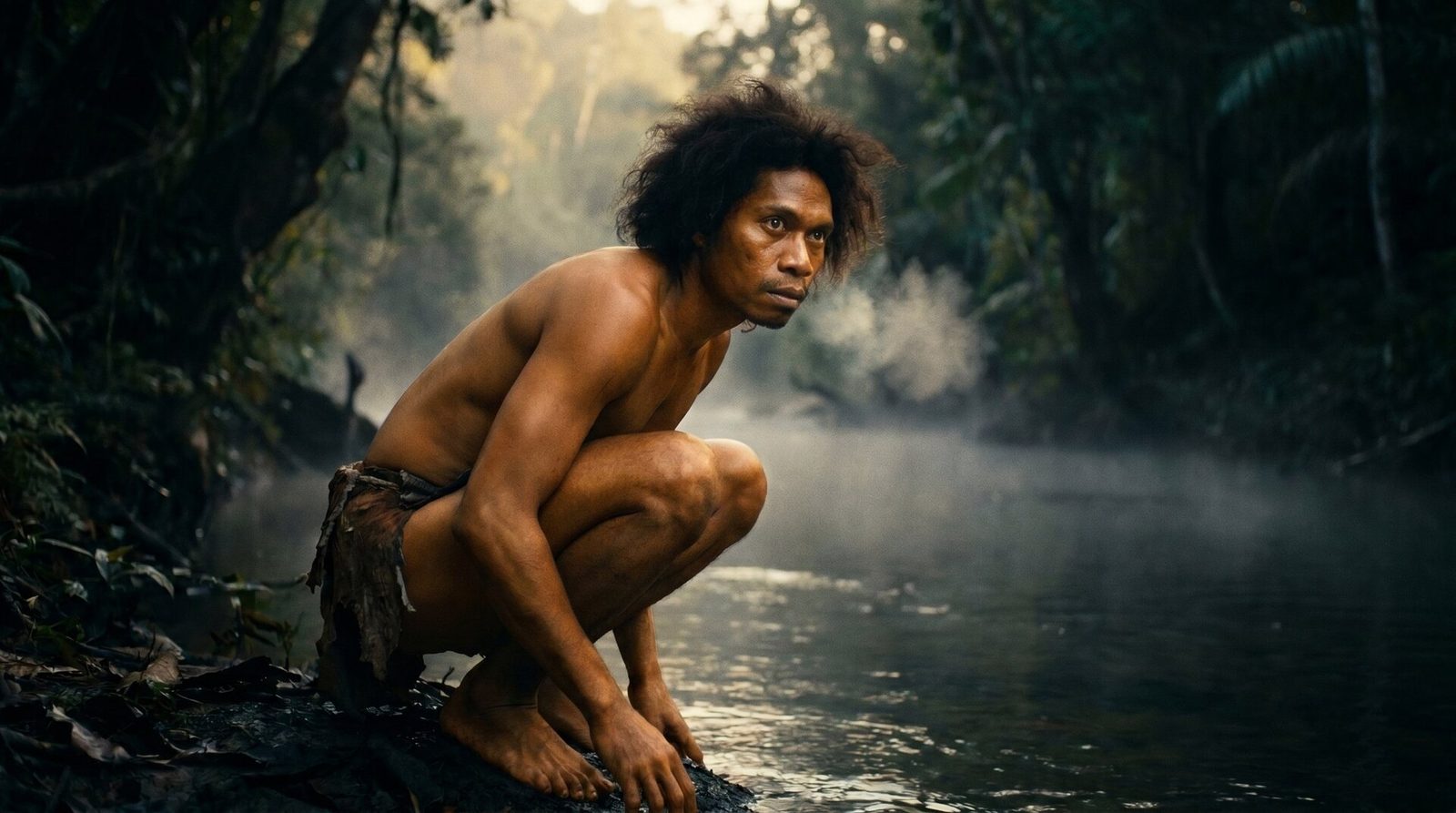
A man crouches alone at the river's edge at dawn, alert, half animal and half something new. This is the threshold the film keeps returning to, the narrow gap between instinct and intention. What our ancestors do next is how a species decides what it becomes.
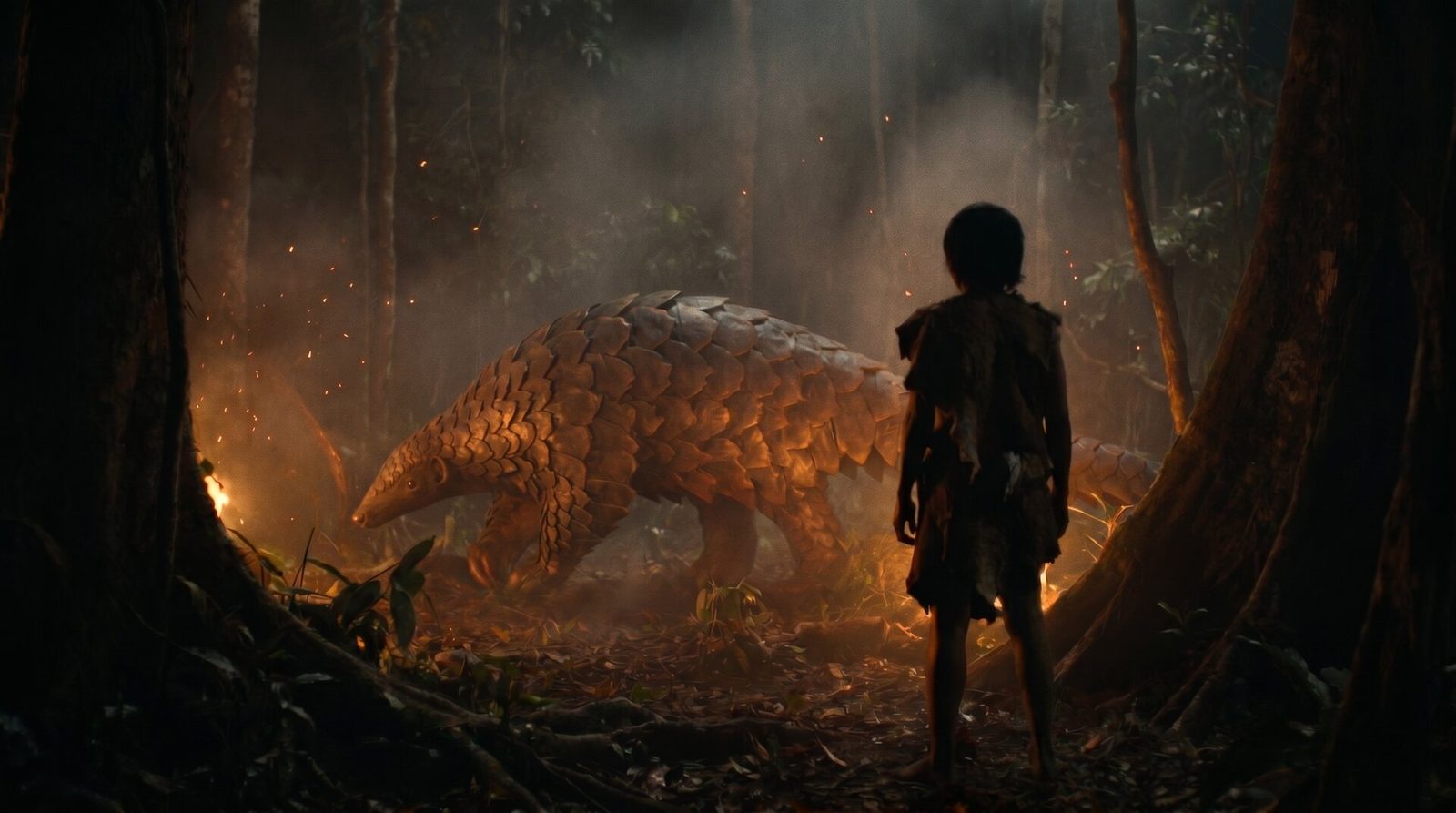
Meet Tebo 1: around ten or eleven, a young Homo sapiens, standing small before a giant pangolin, three metres of armoured scale, in an ember-lit forest. This is the world that made us, full of magic, danger, and potential, where wonder and threat are rarely far apart.
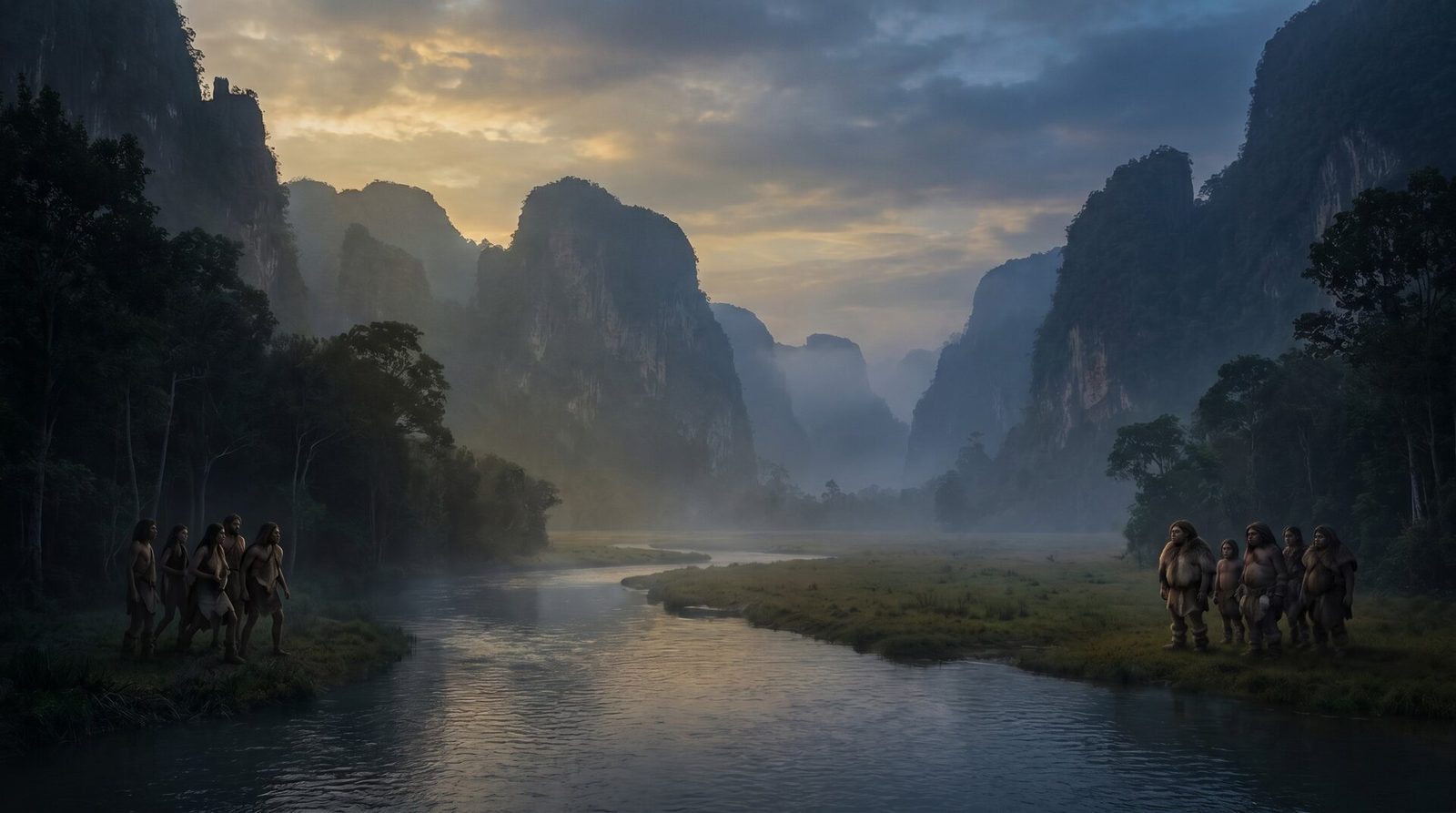
Dawn over a misty valley. On one bank our slender band; on the far bank a stockier people, the Denisovans. Two kinds of human hold their distance across the water, strangers in the same world. The film's second question is planted here: when we meet the other, do we close the distance, or widen it?
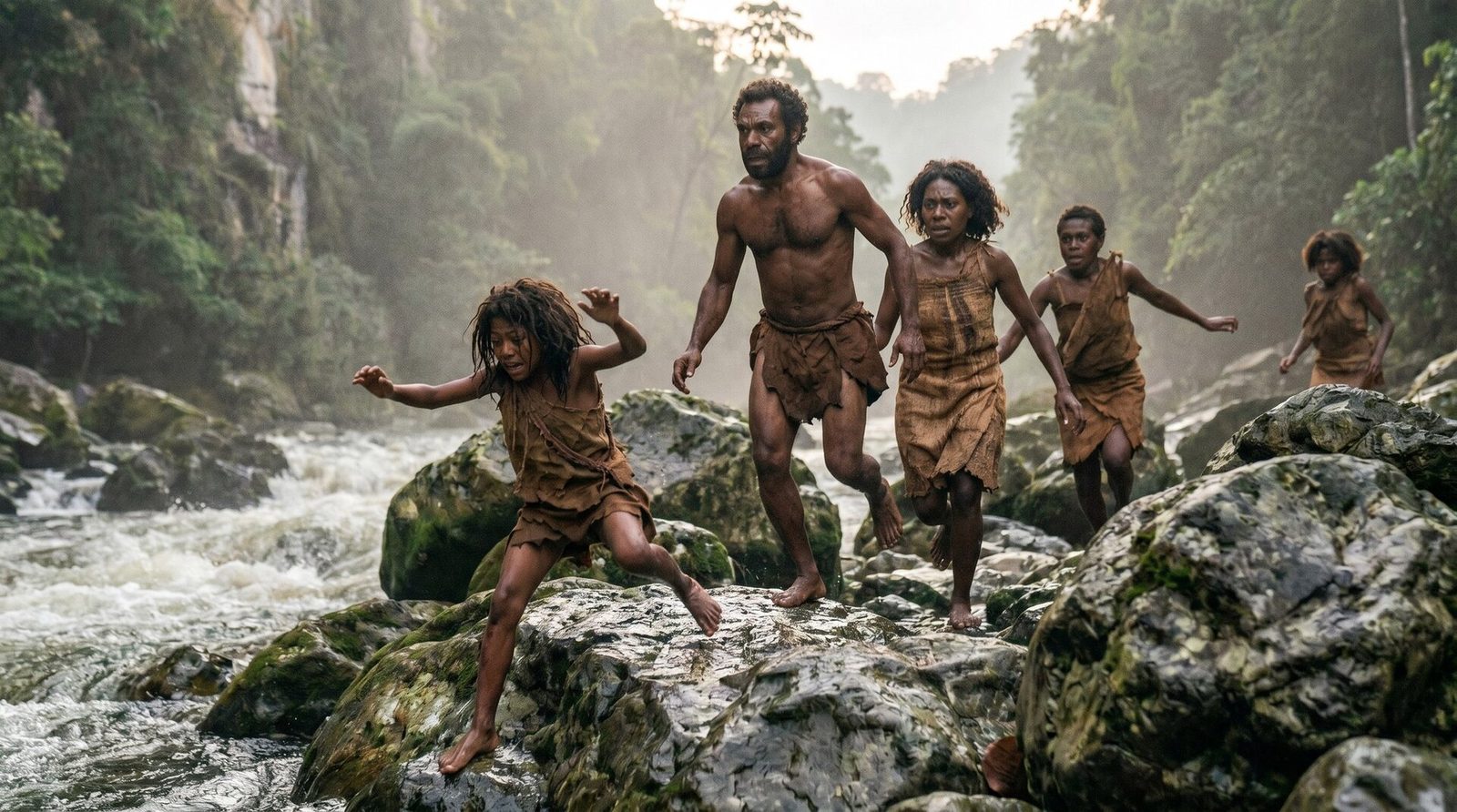
Fear answers first. The family bolts across the wet boulders of a river gorge, and Tebo 1, scrambling to keep up over the slick stone, slips. The accident that starts everything comes not from a hunt but from flight, from running scared of the strangers across the water.
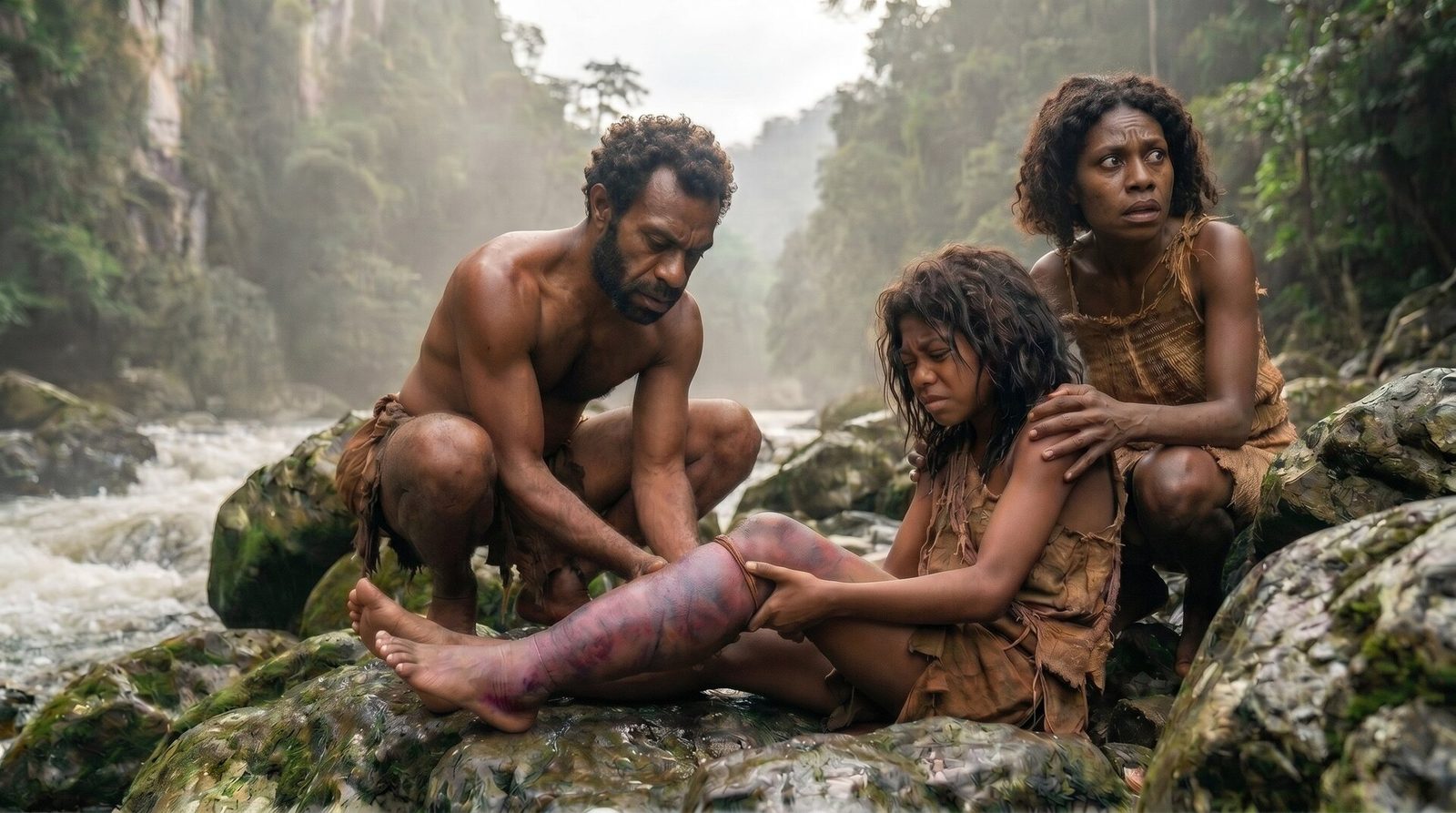
The leg is shattered on the rocks, Tebo 1 white with shock as kin close in. By the old law of a people who live by their speed, this is where the group moves on. The engine of the story: a body that can no longer keep up, and a community that must decide.
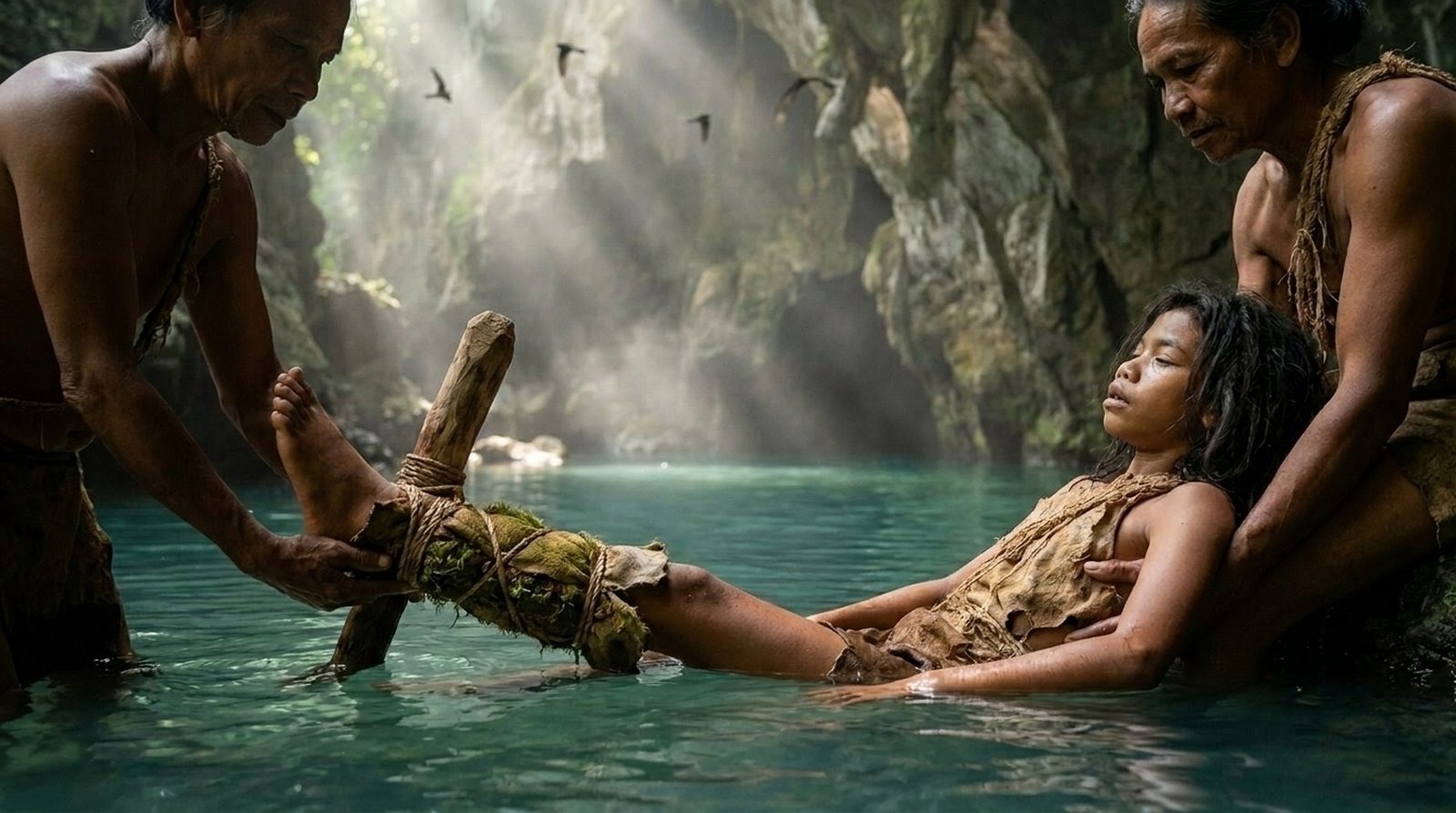
Before any darker choice, they try to save the leg. Two elders cradle Tebo 1 in the turquoise spring where the river is born, the splinted limb eased into cold, clear water. Every remedy they know is spent here, in hope, before anyone reaches for the blade.
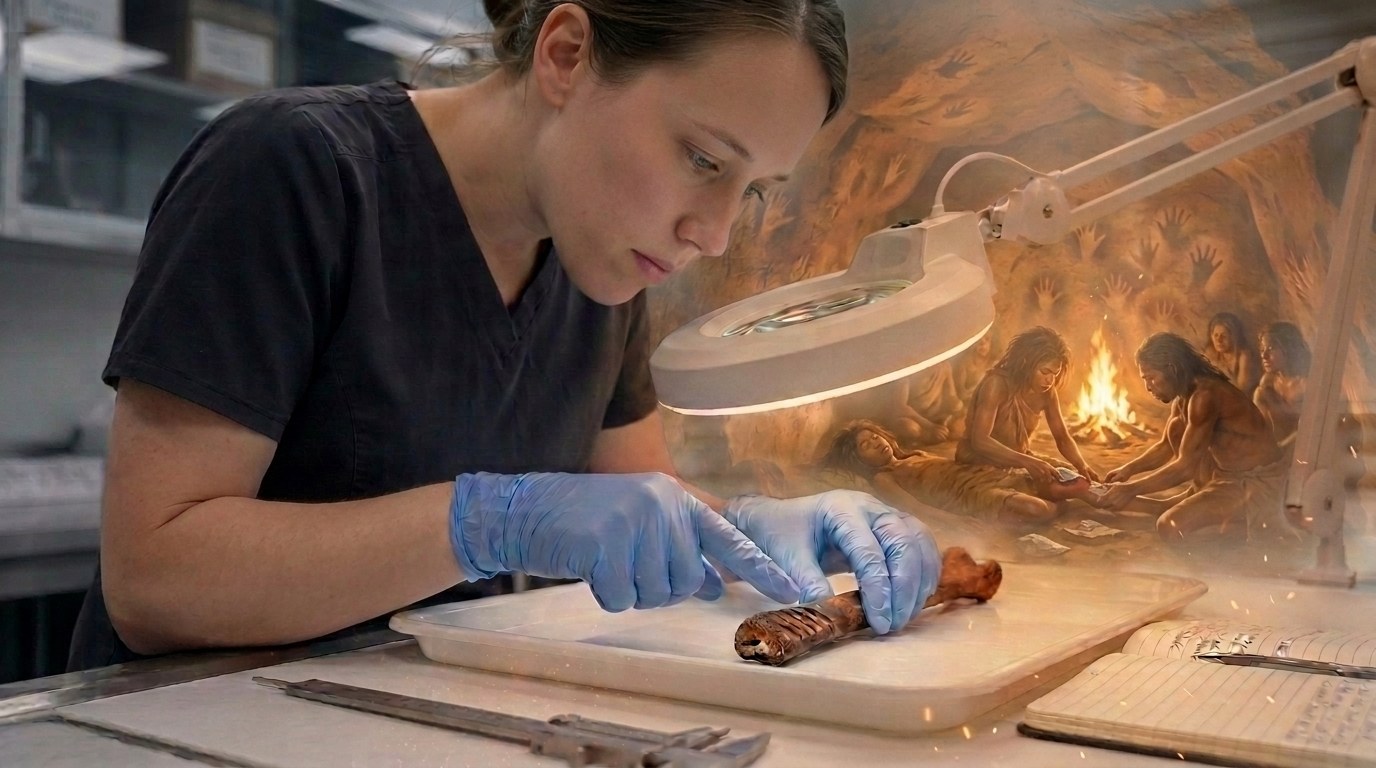
Present day. A bioarchaeologist turns the amputated bone under a lamp, reading the clean cut and the years of healed regrowth around it, proof that Tebo 1 survived and was cared for. As she looks, the lab dissolves into firelight. This is how the film moves: each piece of evidence a portal, and where the evidence runs out, the story begins.
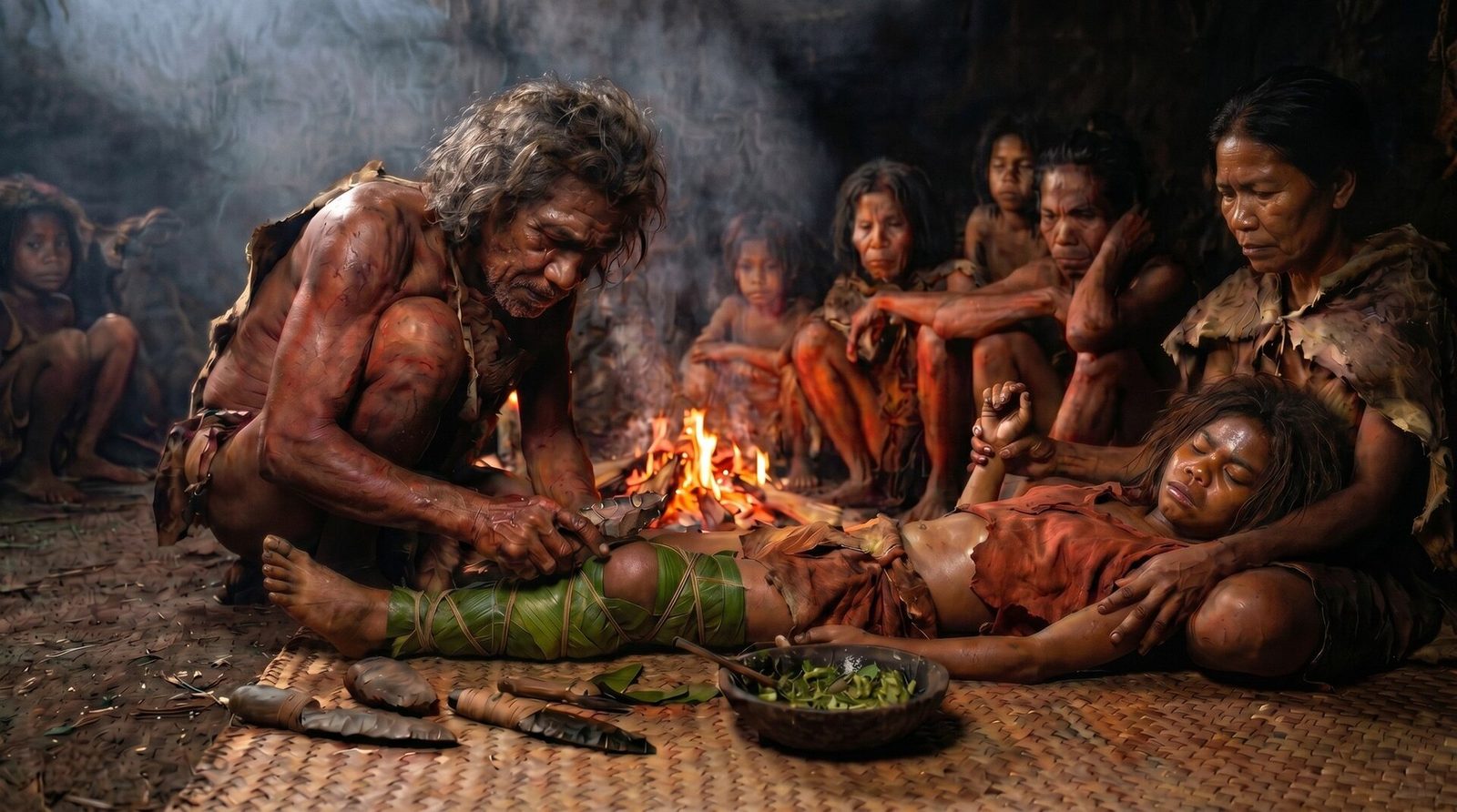
By firelight the old healer takes up a stone blade. The community holds Tebo 1 still, an elder cradling the head, plant medicine at hand, as the healer cuts away the ruined limb to save the life. The oldest known successful operation, performed not to conquer death but to keep one of their own.
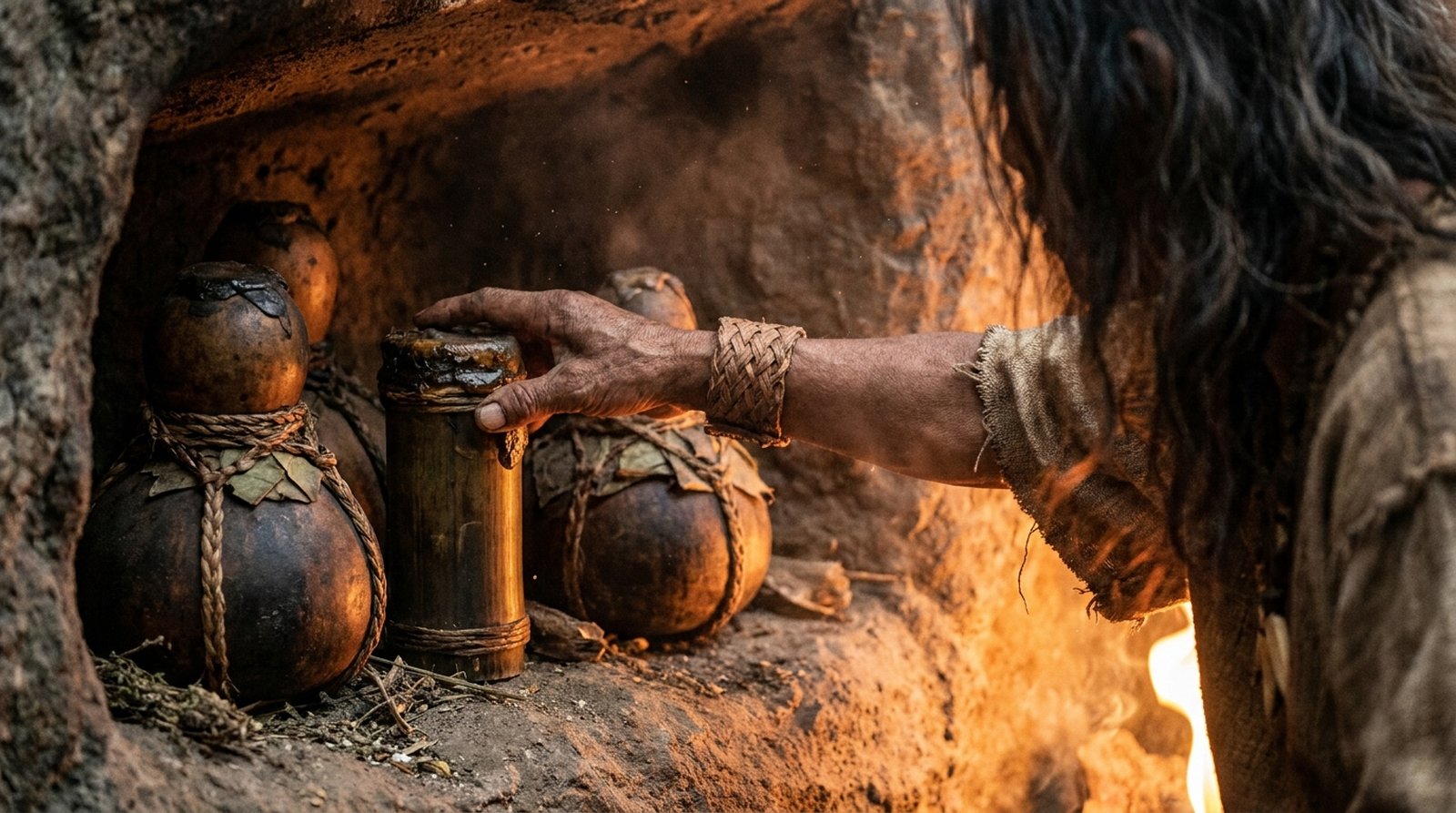
Three sealed vessels of plant medicine, gathered, prepared, and kept. Knowledge as an act of care, carried from one generation to the next, the quiet groundwork that makes survival after the cut possible.
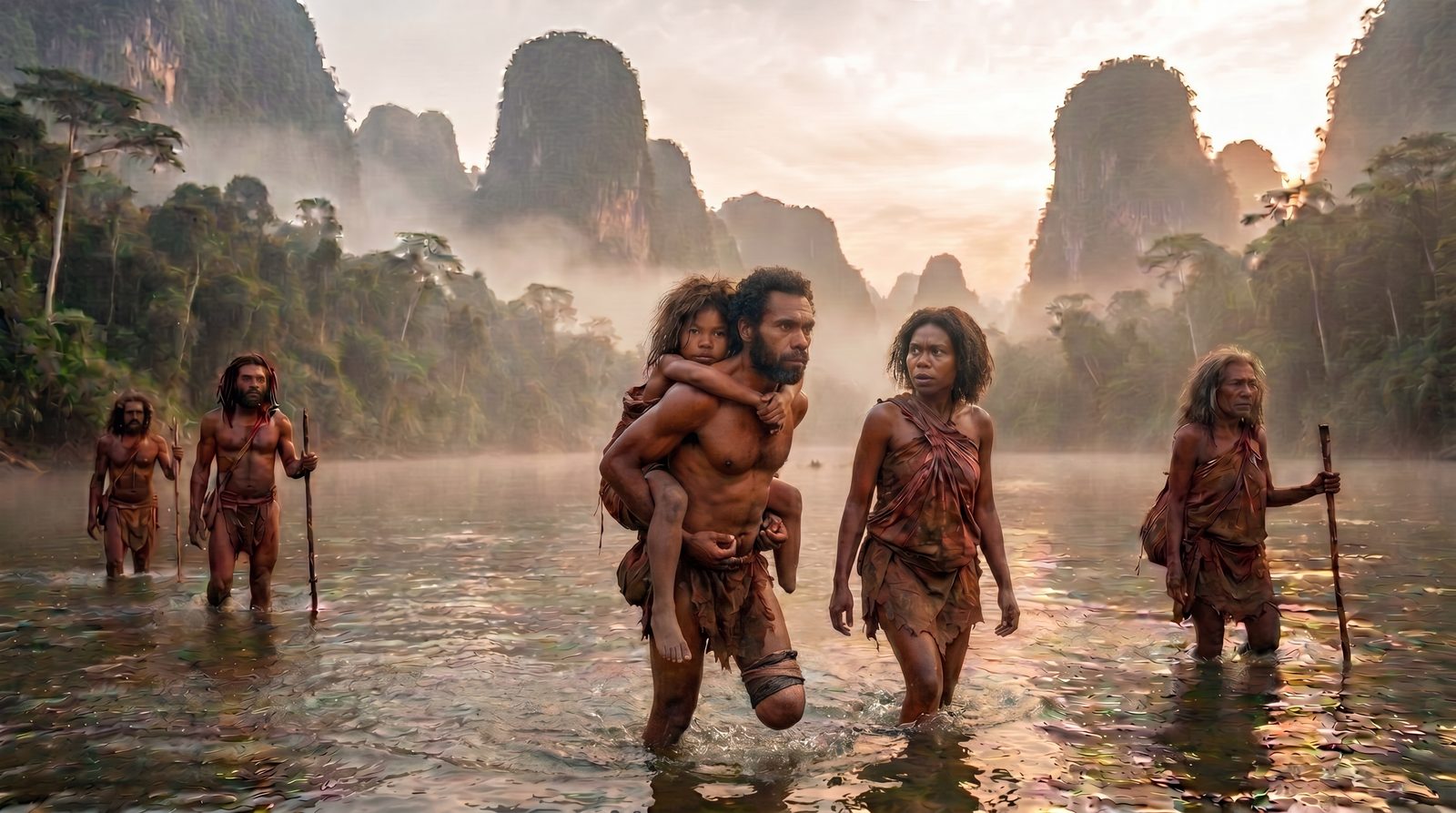
Across rivers and ridges, season after season, the band bears Tebo 1 between them, women and men together. No grand gesture, just the daily weight of choosing not to leave Tebo 1 behind. The heart of the film is here, in the carrying.
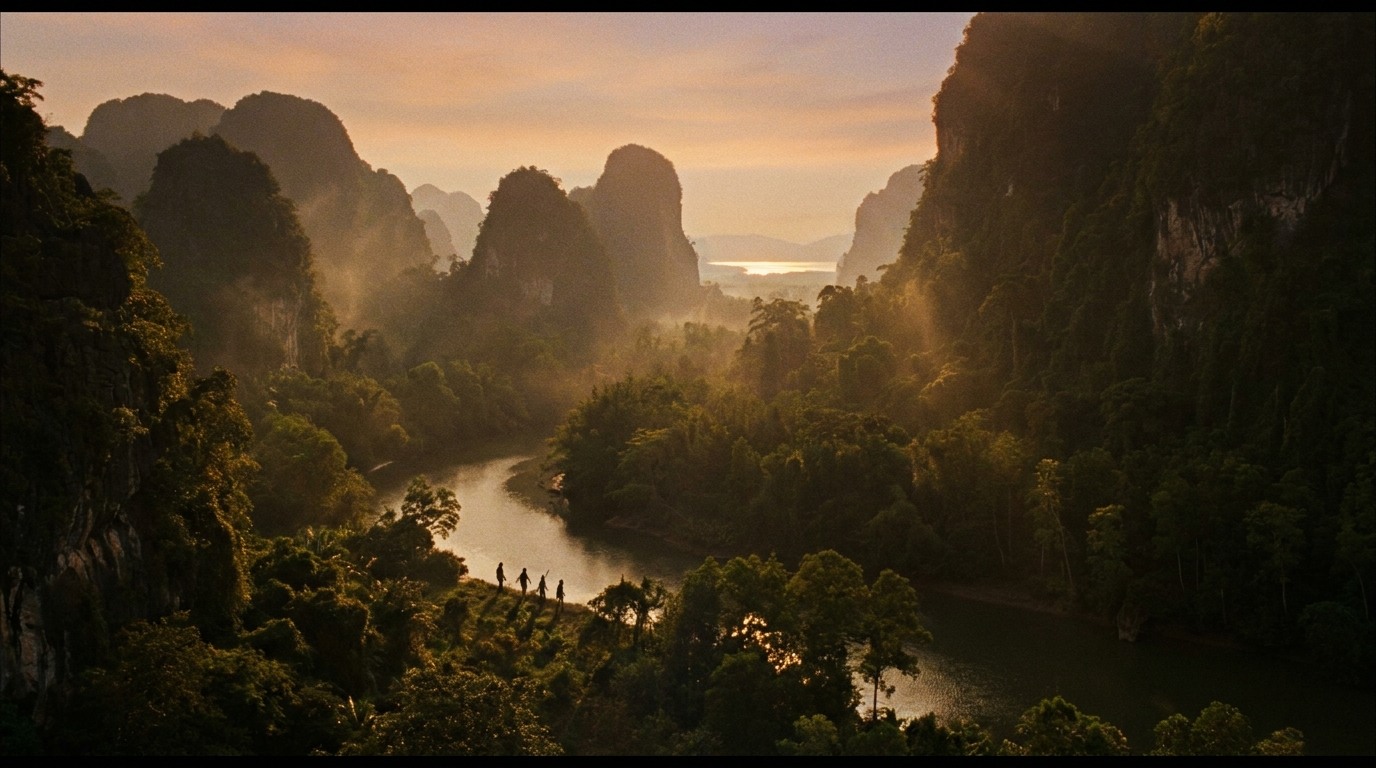
A wide, lonely valley, the band strung along the river, Tebo 1 slowing them. A people who survive by their speed are keeping the one who cannot keep up. To carry Tebo 1 defies the oldest logic of survival and proves a deeper one. Compassion, not conquest, is the choice that sets us apart.
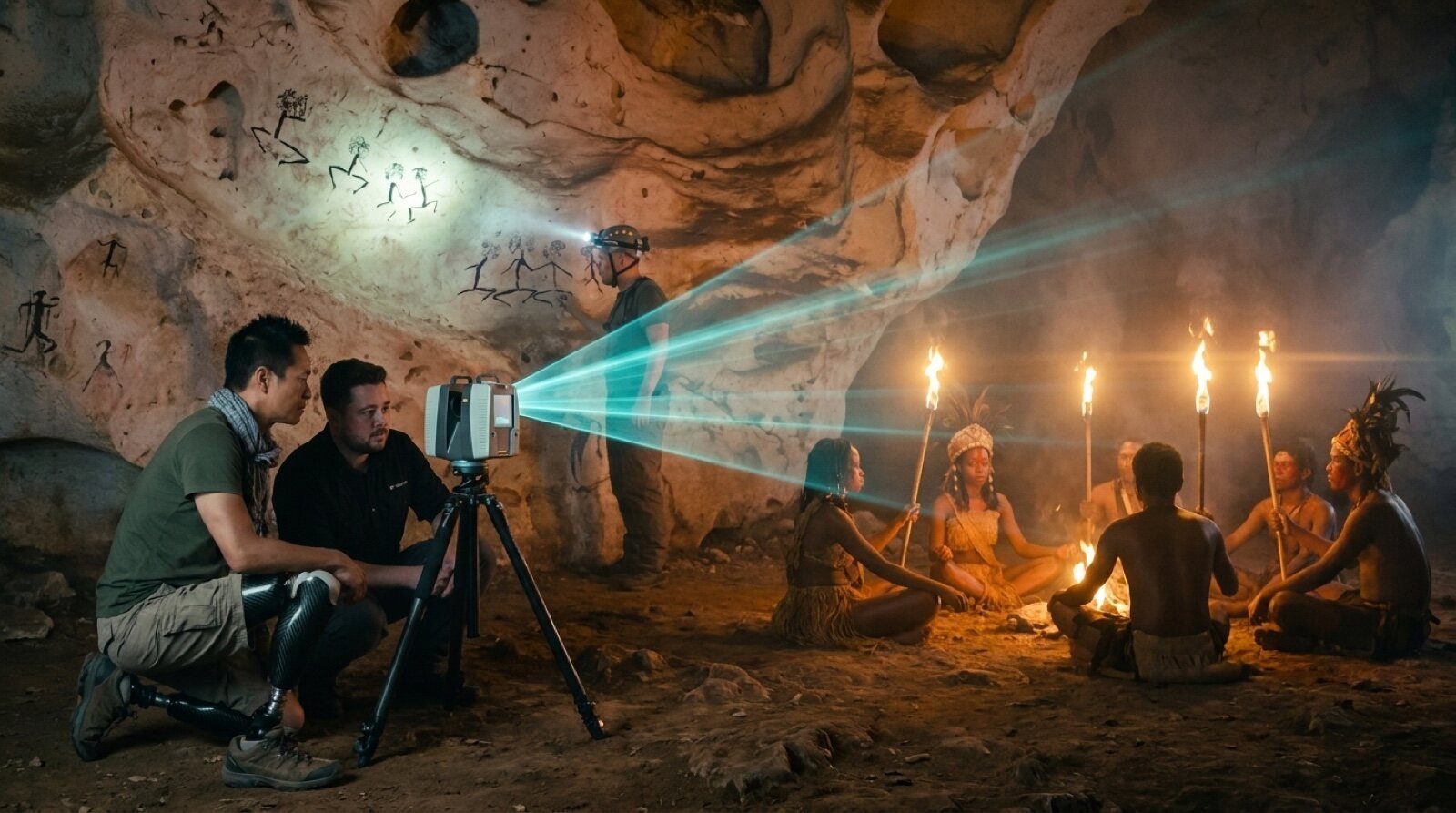
Present and past in one frame: Albert and Maxime watch a LiDAR scanner sweep the painted ceiling while, in the same cave, the ancient community sits in a firelit ritual circle. The scan reads the marks; the marks open into the gatherings that made them, where shared care first bound a band into a community.
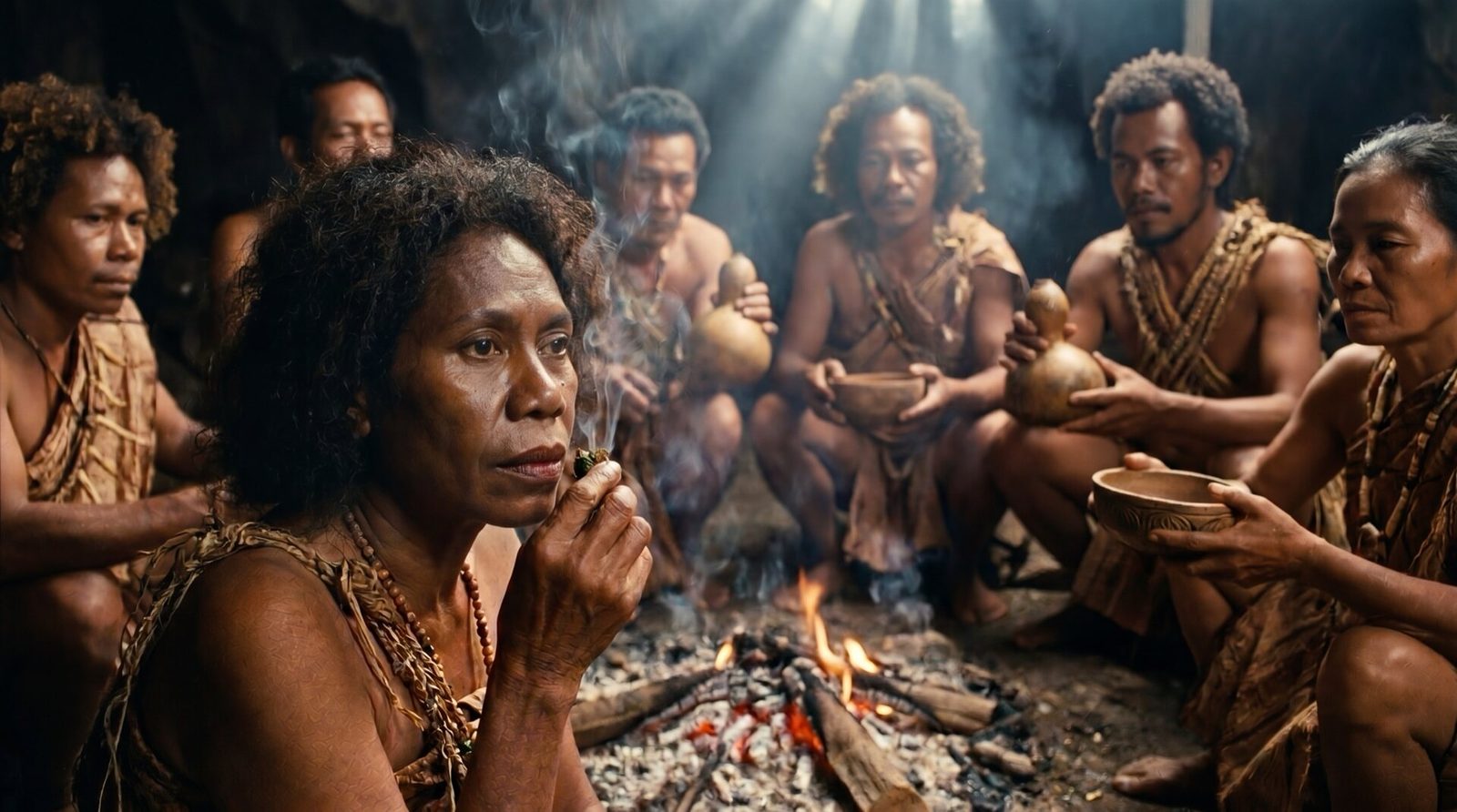
Around the fire, betel and smoke pass hand to hand, an elder's gaze gone far. Ritual opens a new power, a mind that can picture what is not in front of it. The same plasticity that taught Tebo 1's body to walk again now reaches past the world as it is toward the worlds that could be. To imagine the unreal is the first step to building it: the carved leg, the painted beast, the boat, the spirit. Here meaning starts to outrun survival, and something like consciousness begins.
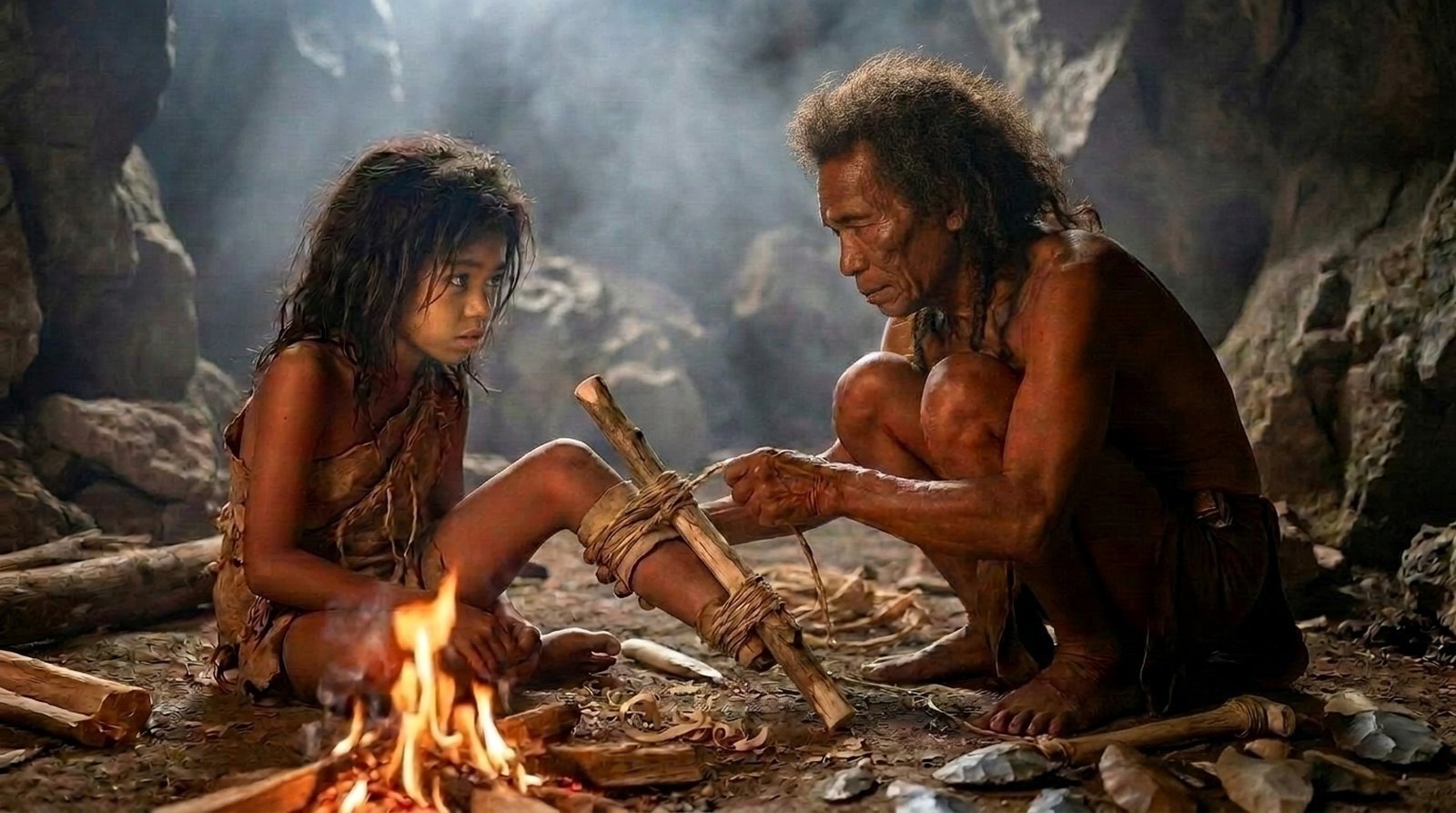
In the cave, the old craftsman binds a carved wooden peg to the healed stump while Tebo 1 watches every knot. Not pity but invention, love expressed as engineering. The first prosthesis, made so a life can be lived, not only saved.
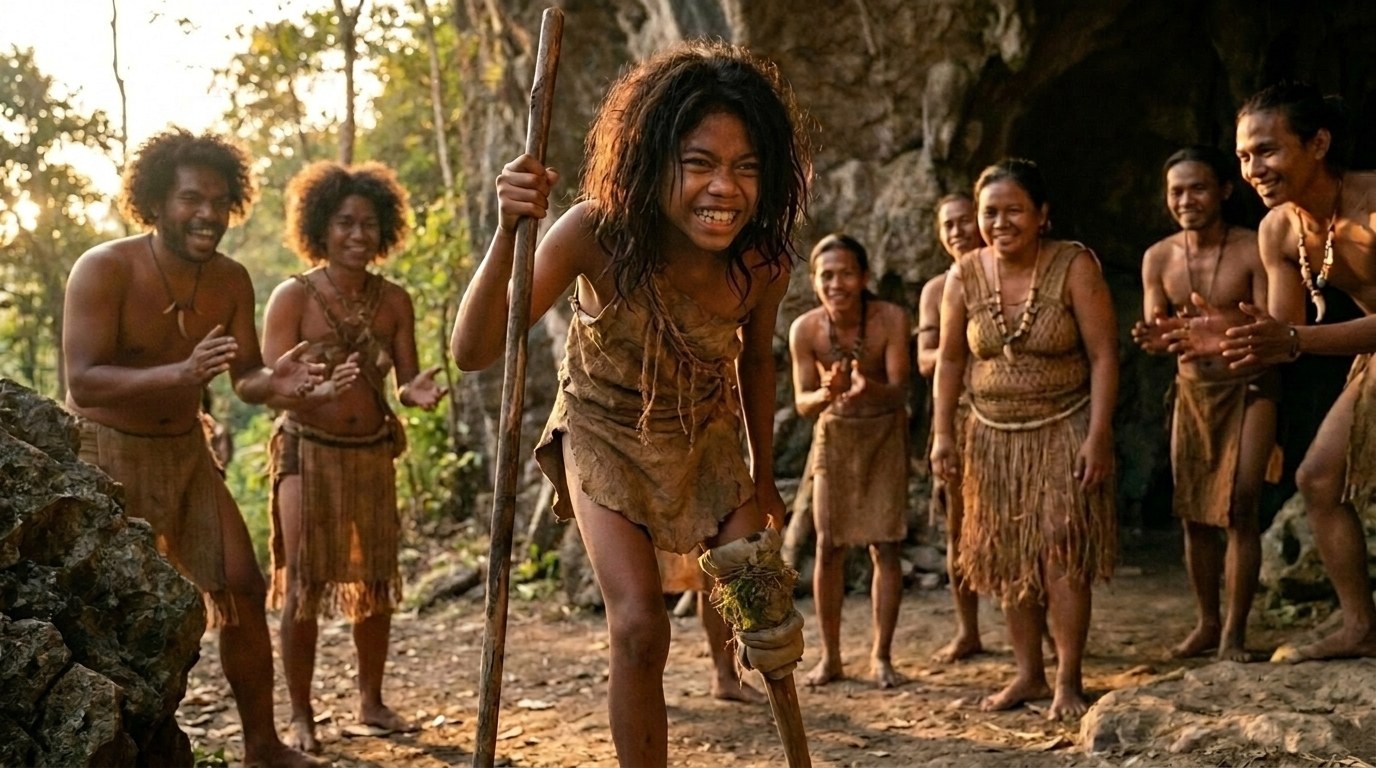
Peg and staff beneath, teeth bared with effort, Tebo 1 takes the first steps alone, and the whole band erupts. A burst of pure joy, and the turn of the story, from the one who is carried to the one who walks.
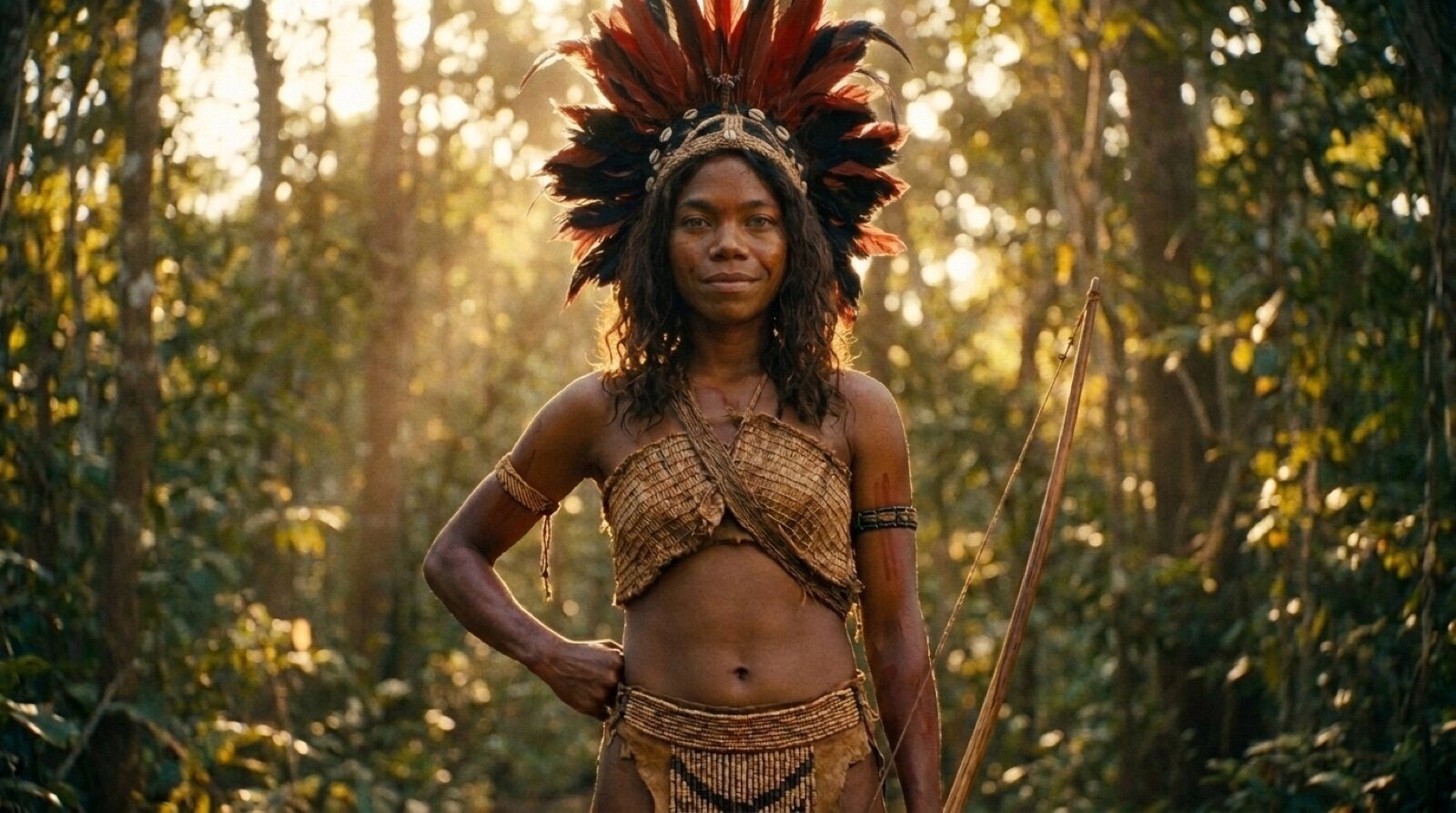
Meet Bulan, a young huntress who never once saw Tebo 1 as broken. She becomes the one who pulls Tebo 1 forward, and together they invent new ways to move, to hunt, to belong. Care widens here, from keeping Tebo 1 alive to building a life.
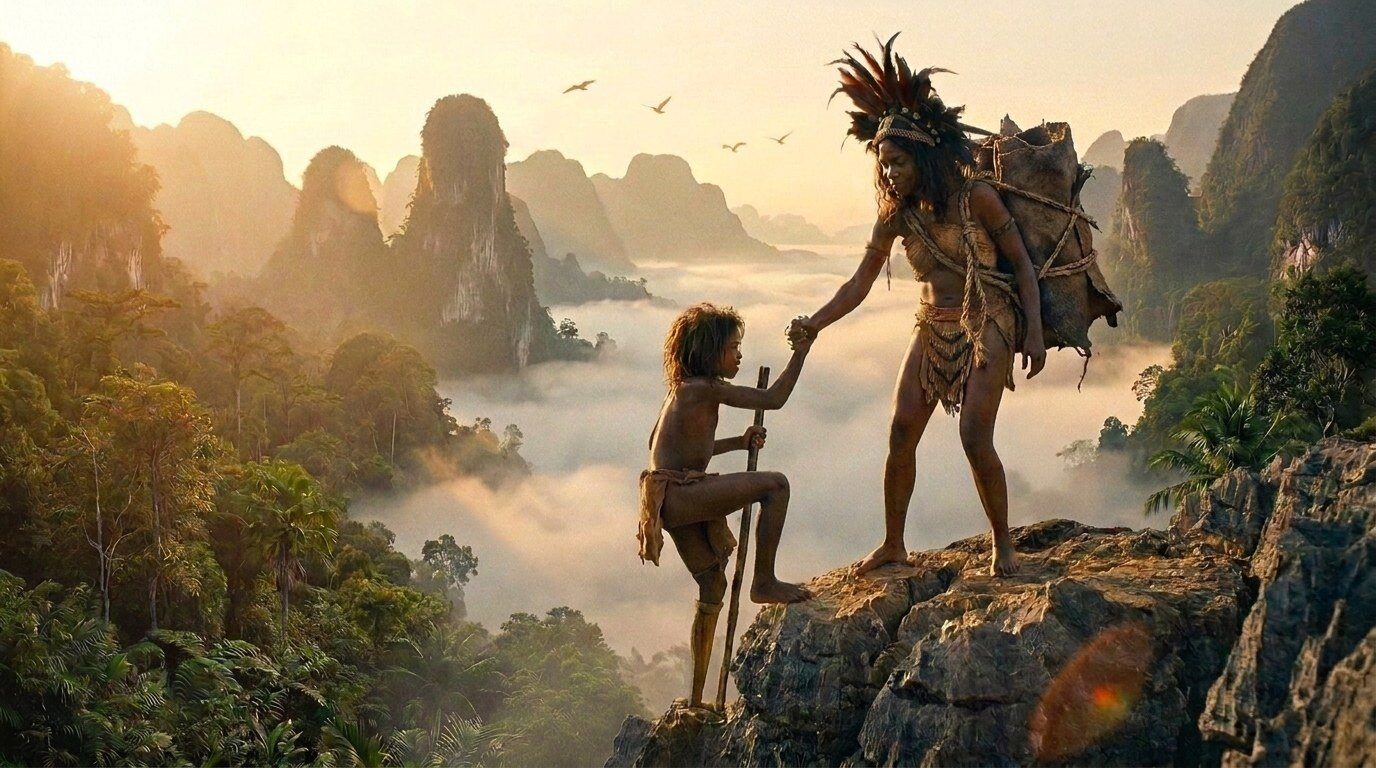
At a clifftop above an ocean of cloud, Bulan reaches down and pulls Tebo 1 up onto the lookout. No one carries Tebo 1 here and no one pities Tebo 1. This is partnership, the heights made theirs together.
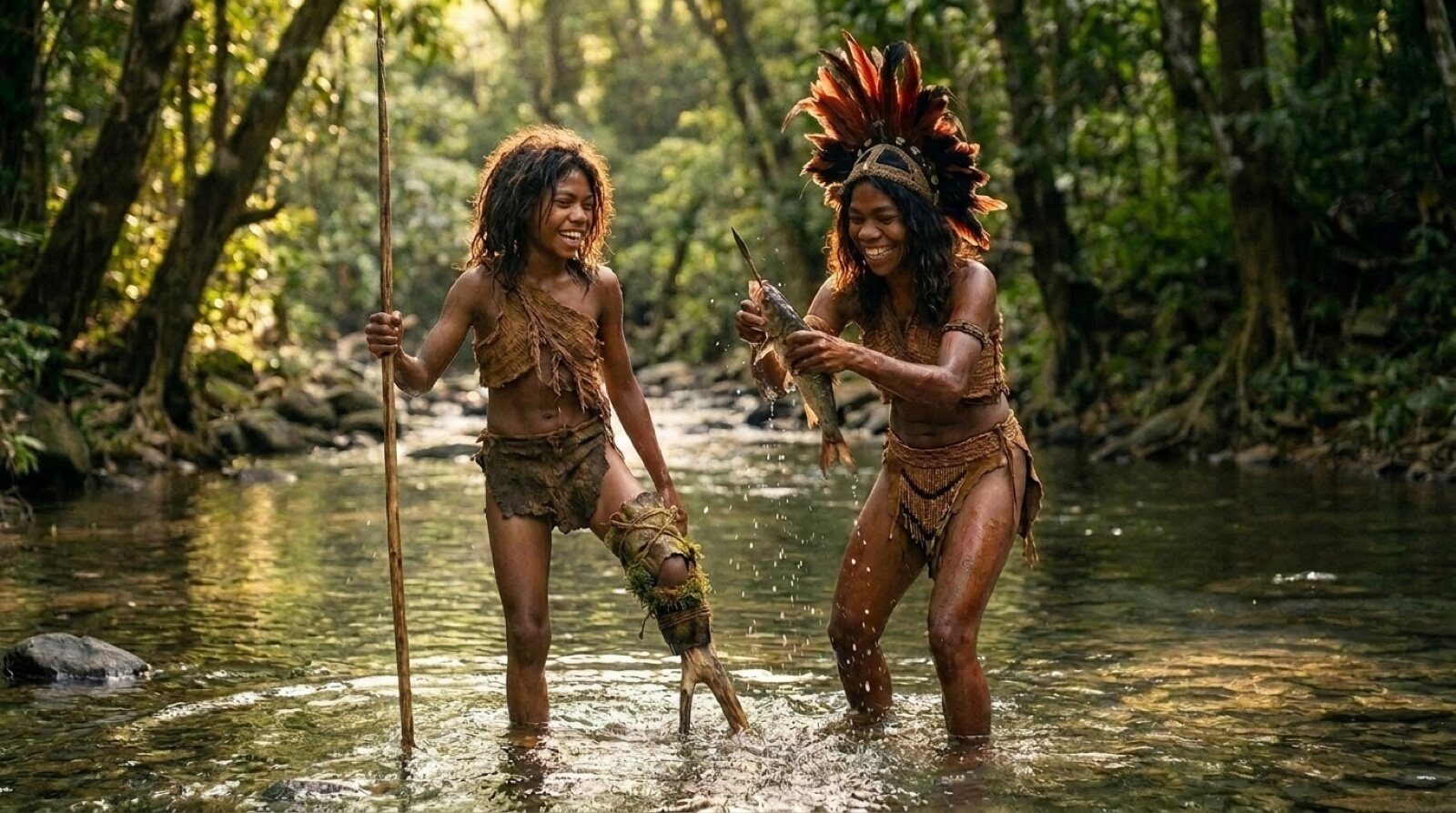
On a peg built for mud and water, fast and sure in the shallows, Tebo 1 and Bulan spear fish and laugh, soaked and free. The film exhales. This is no longer survival; it is a life worth living.
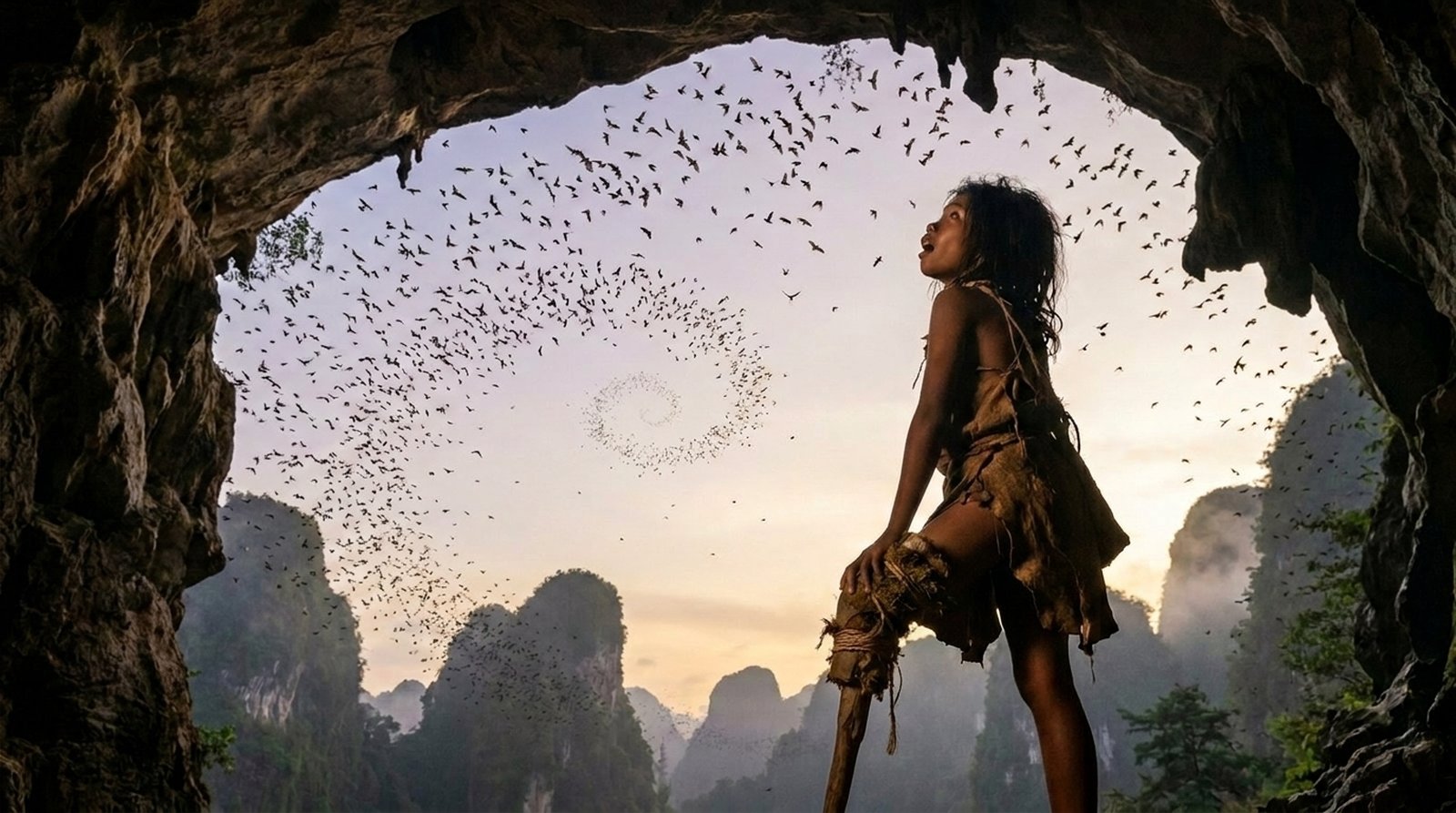
At dusk Tebo 1 stands in the cave mouth as a living spiral of bats pours into the sky. Grounded while the others hunt, Tebo 1 becomes a reader of the world, learning the weather and the hour in the turning of the swarm.
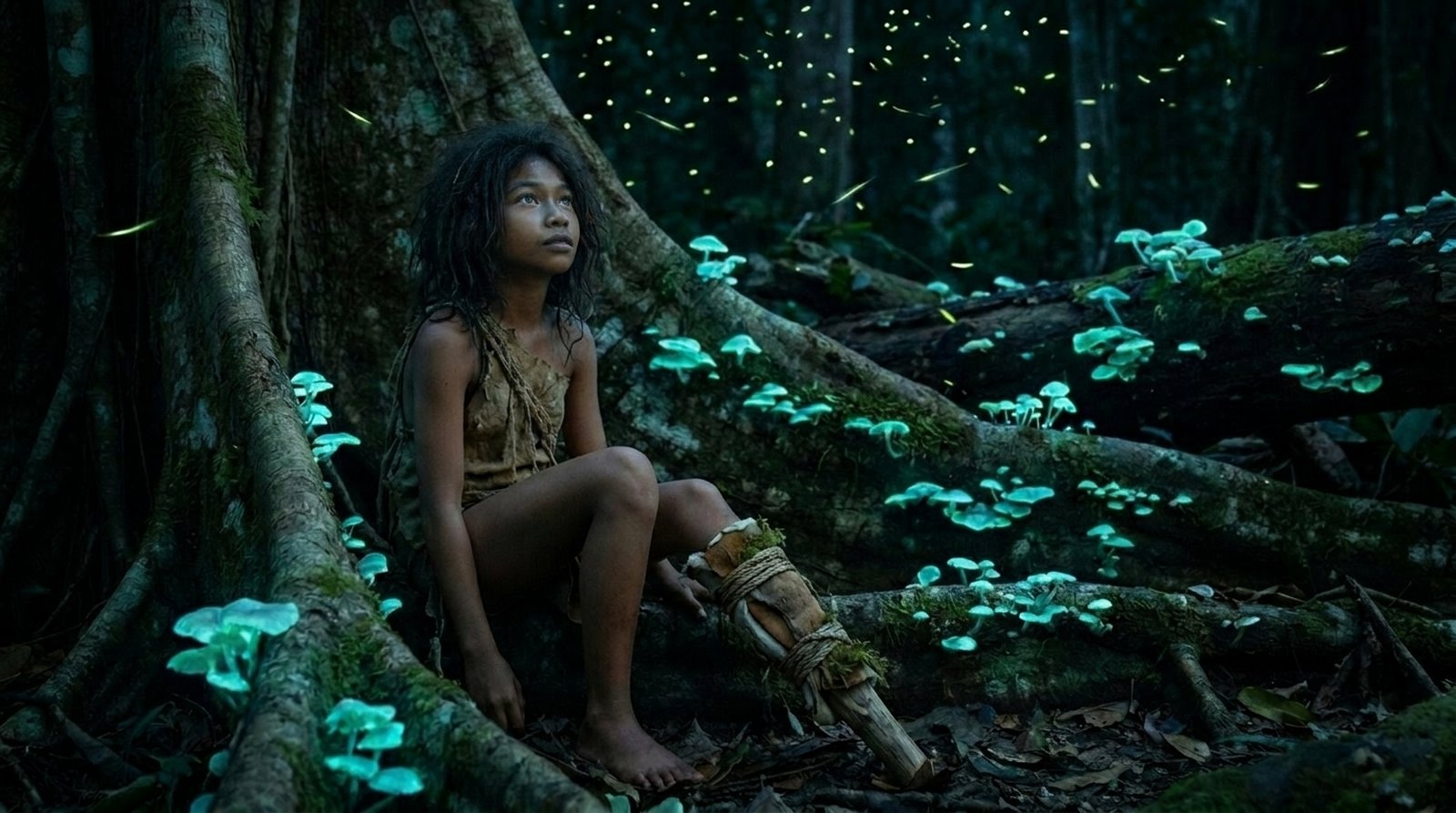
Left behind on the trail, Tebo 1 finds the forest floor alight, bioluminescent fungi and a pulse of synchronized fireflies. What looked like exclusion becomes a gift: stillness shows Tebo 1 the magic the always-moving never stop to see.
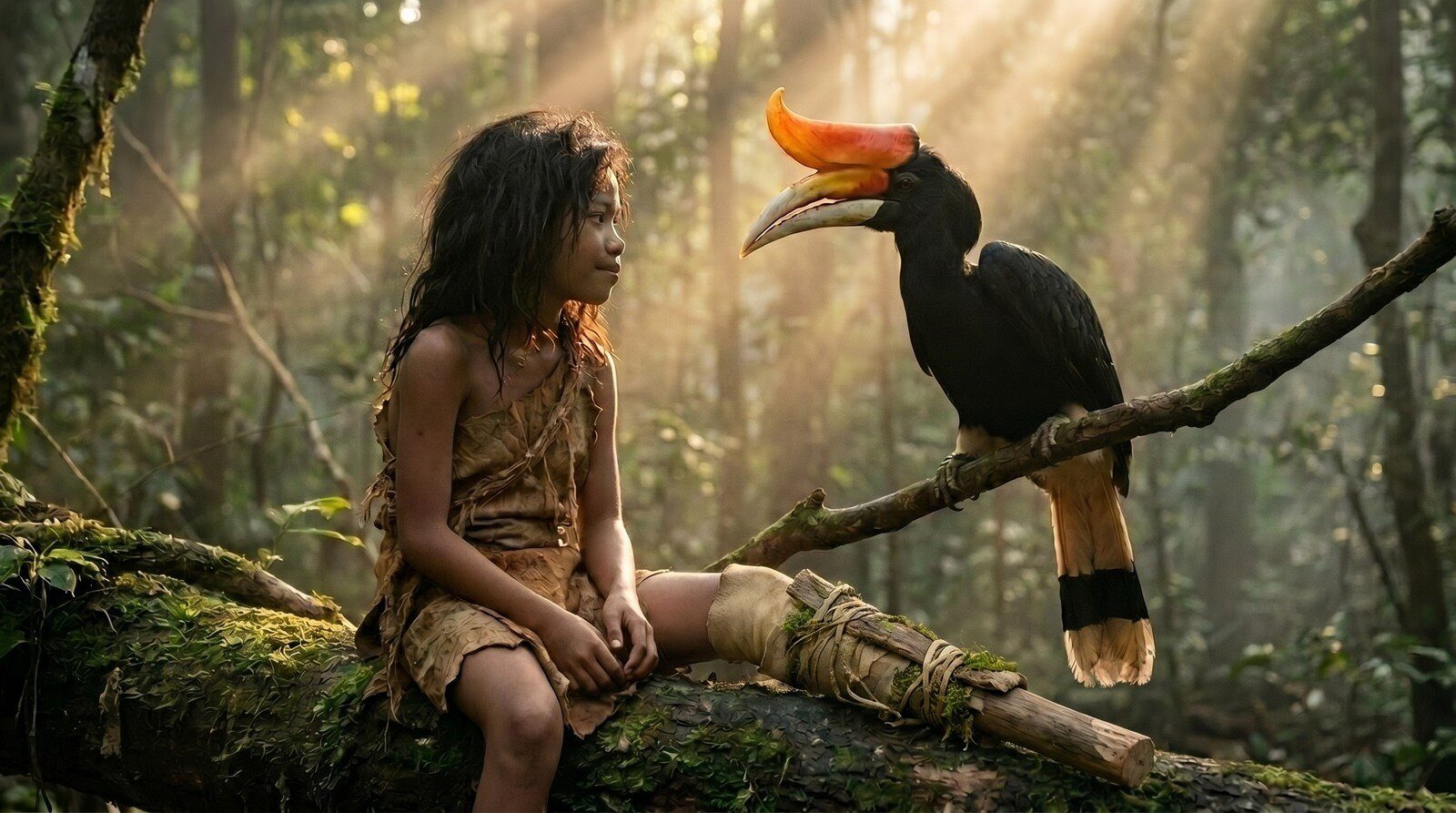
A rhinoceros hornbill, in Dayak belief a messenger between the living world and the spirit world, settles beside Tebo 1 and stays. The one who cannot run is the one the wild comes to. Tebo 1's difference is becoming a kind of sight.
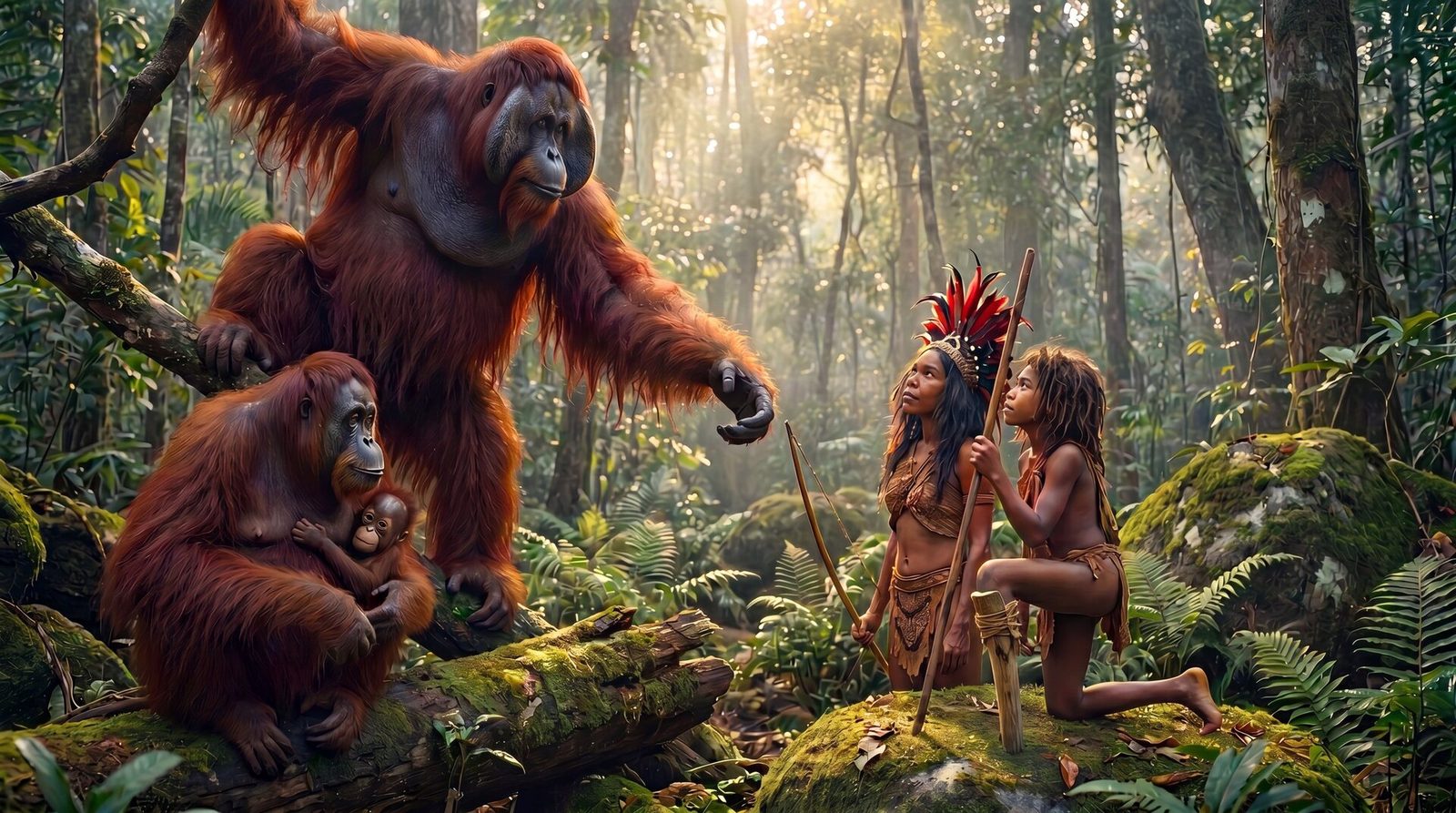
Deep in the canopy, an orangutan reaches an open hand toward Tebo 1 and Bulan, a mother and infant near. Tebo 1 meets the giant as a fellow being to understand, not a rival to overpower. A mind shaped by being cared for turns toward co-existence, not dominance.
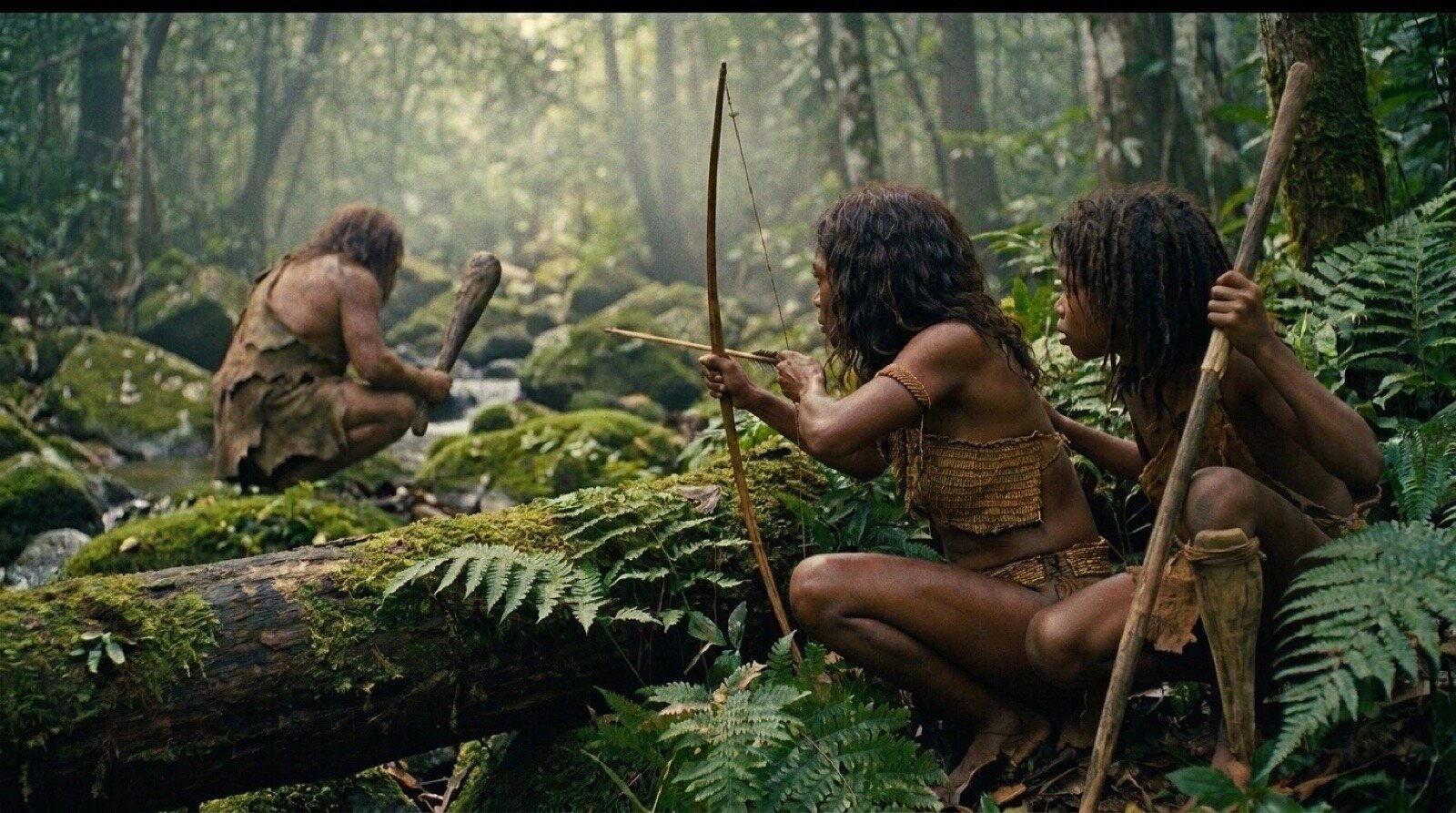
From cover behind a mossy log, Tebo 1 and Bulan spot a lone Denisovan at the stream before the stranger sees them. Bulan's bow comes up; every instinct says run, or strike first. The film holds at the fork between conflict and connection.
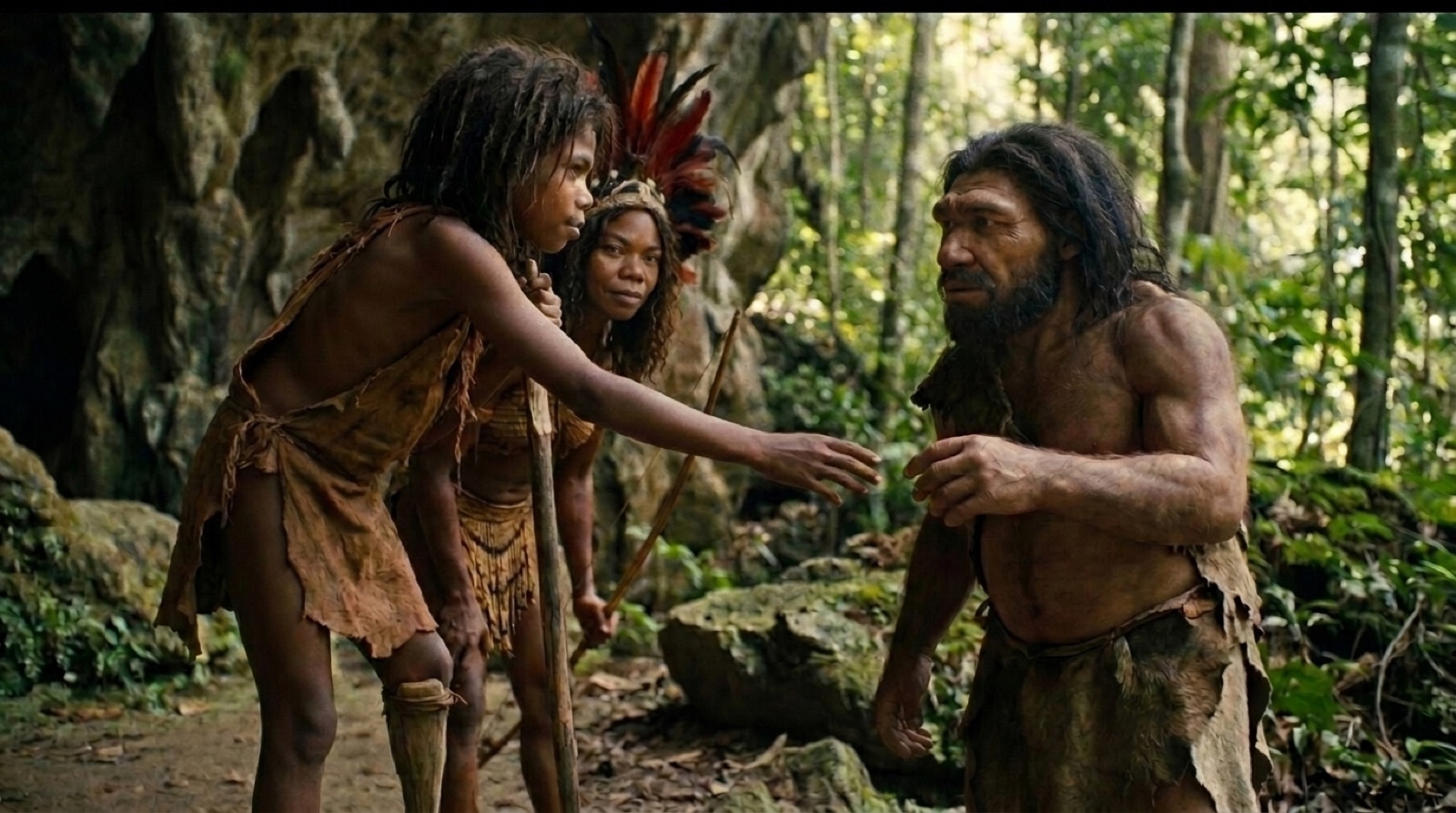
Tebo 1 lowers Bulan's bow and steps out, hand open, toward the wary stranger. Bulan stays guarded. But Tebo 1 has spent a whole life as the different one, carried when keeping up was impossible, finding a place from the edges and being met there with care. Tebo 1 has learned what the others have not: that the line between us and them is not a wall but a choice, and sees no threat, only someone, the same, trying to belong.
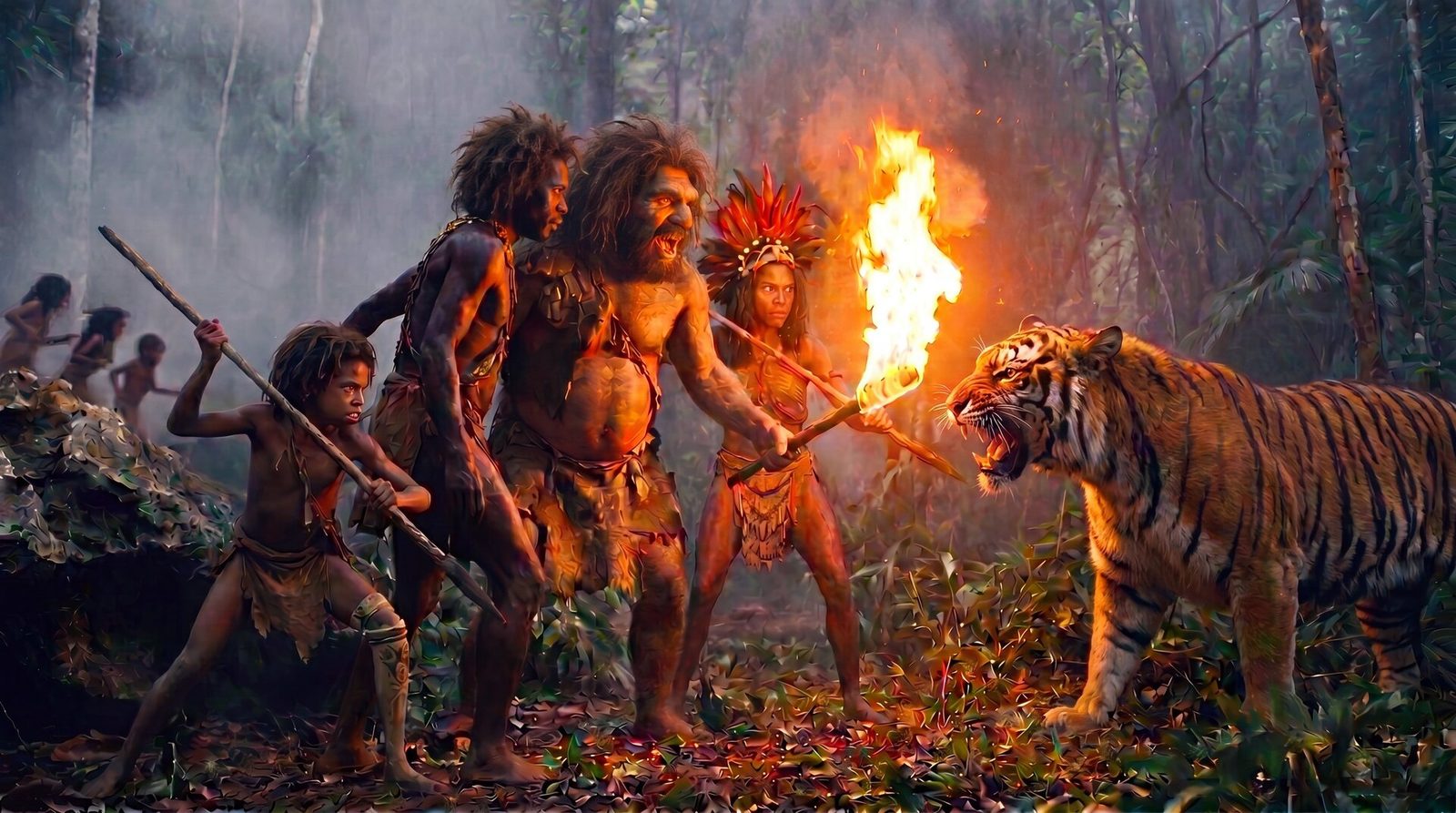
Night, and a tiger comes. Alone, none of them lives till morning. Together, the band, Bulan, and the Denisovan who chose to stand with them hold the line with fire and spears. Apart they are prey; together they endure. What carries them through the night is cooperation, not strength alone.
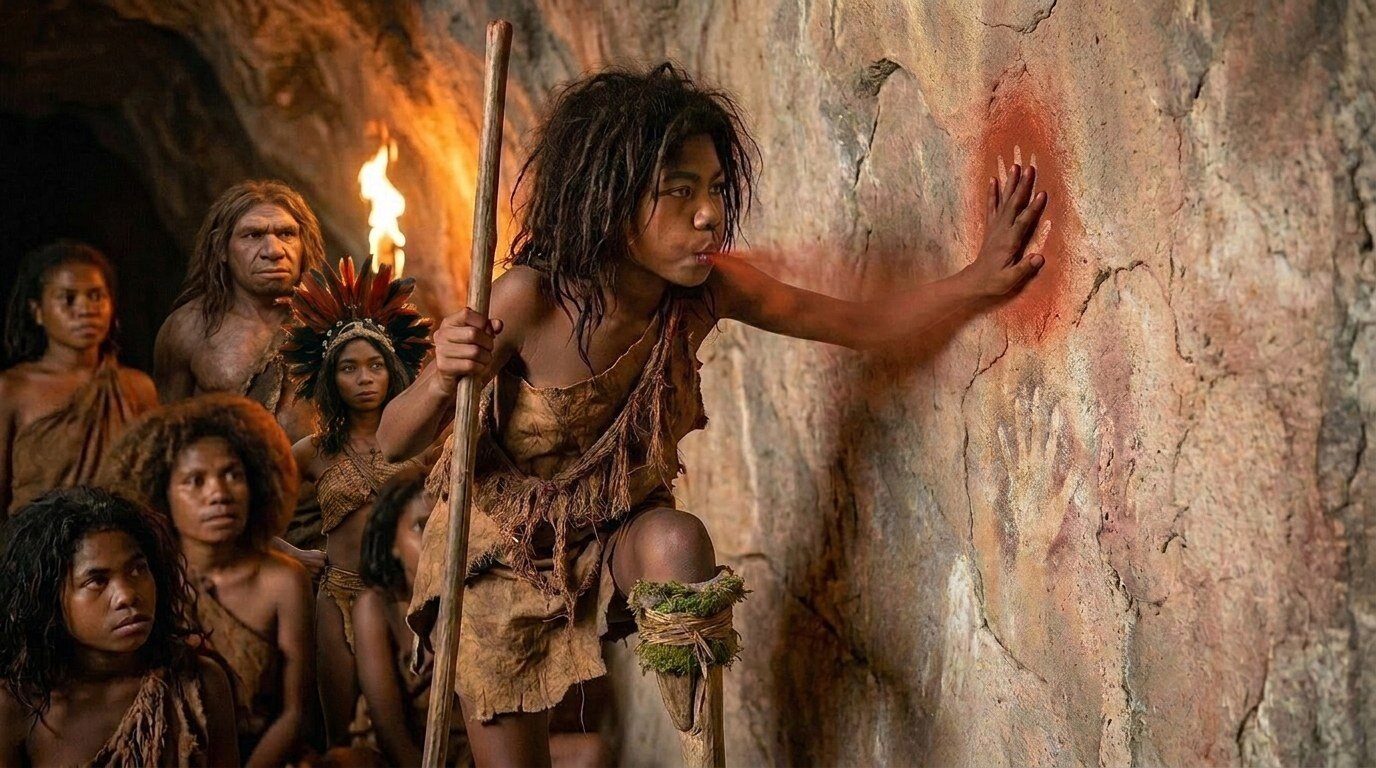
Still young, steady on the peg and staff, Tebo 1 blows red ochre around a pressed hand on the wall while the community, the Denisovan among them, watches by torchlight. The one who was carried becomes the keeper of the story, the one who says: we were here, and we belonged to each other. The care Tebo 1 was once shown has become the bond that made them stronger.
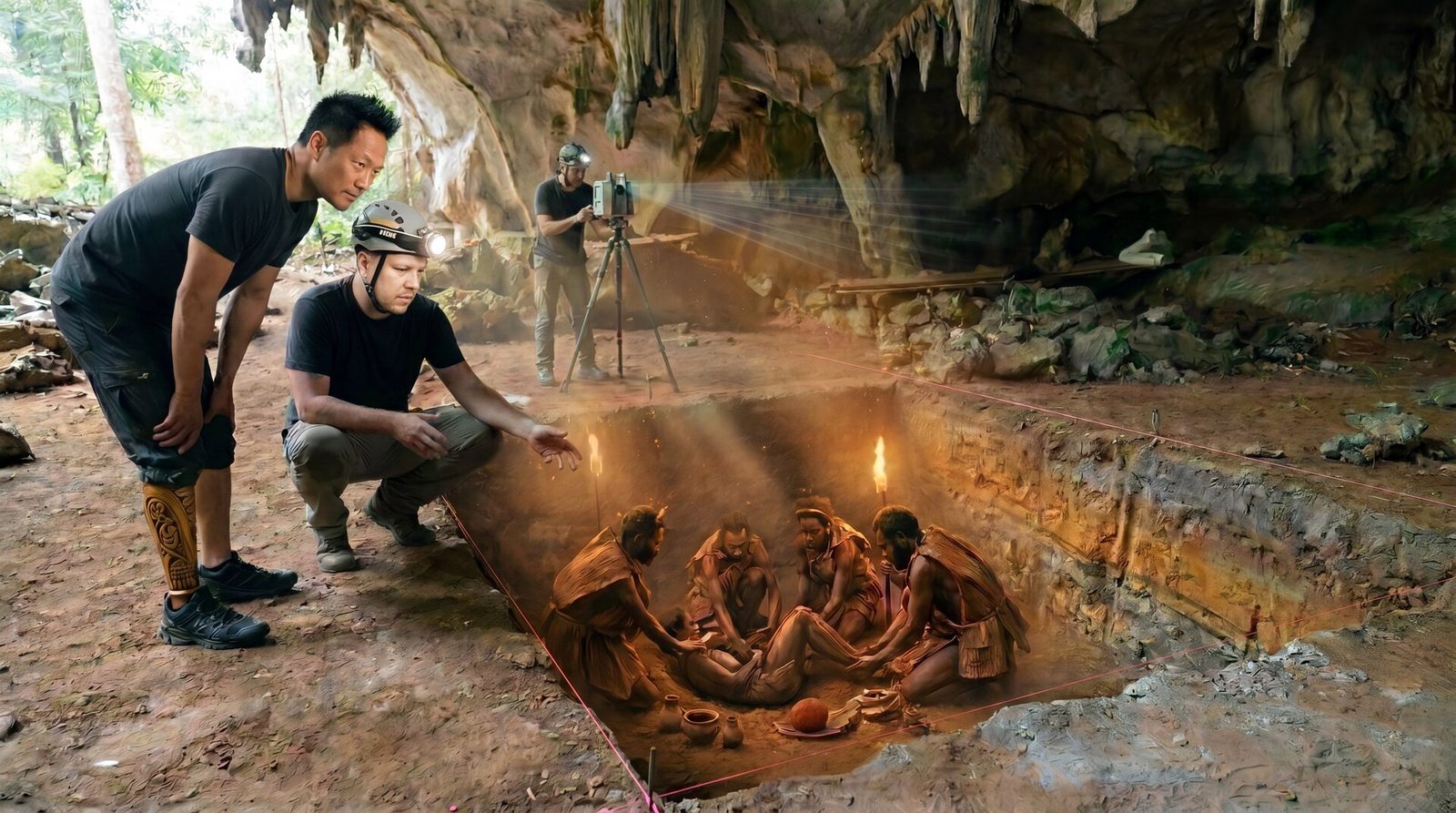
Present day. Maxime walks Albert across the dig, the grid, the soil layers, the exact cut in the cave floor where the skeleton lay. As they trace the trench, the empty grave fills again with the people who once knelt here. The excavation is where the two timelines meet.
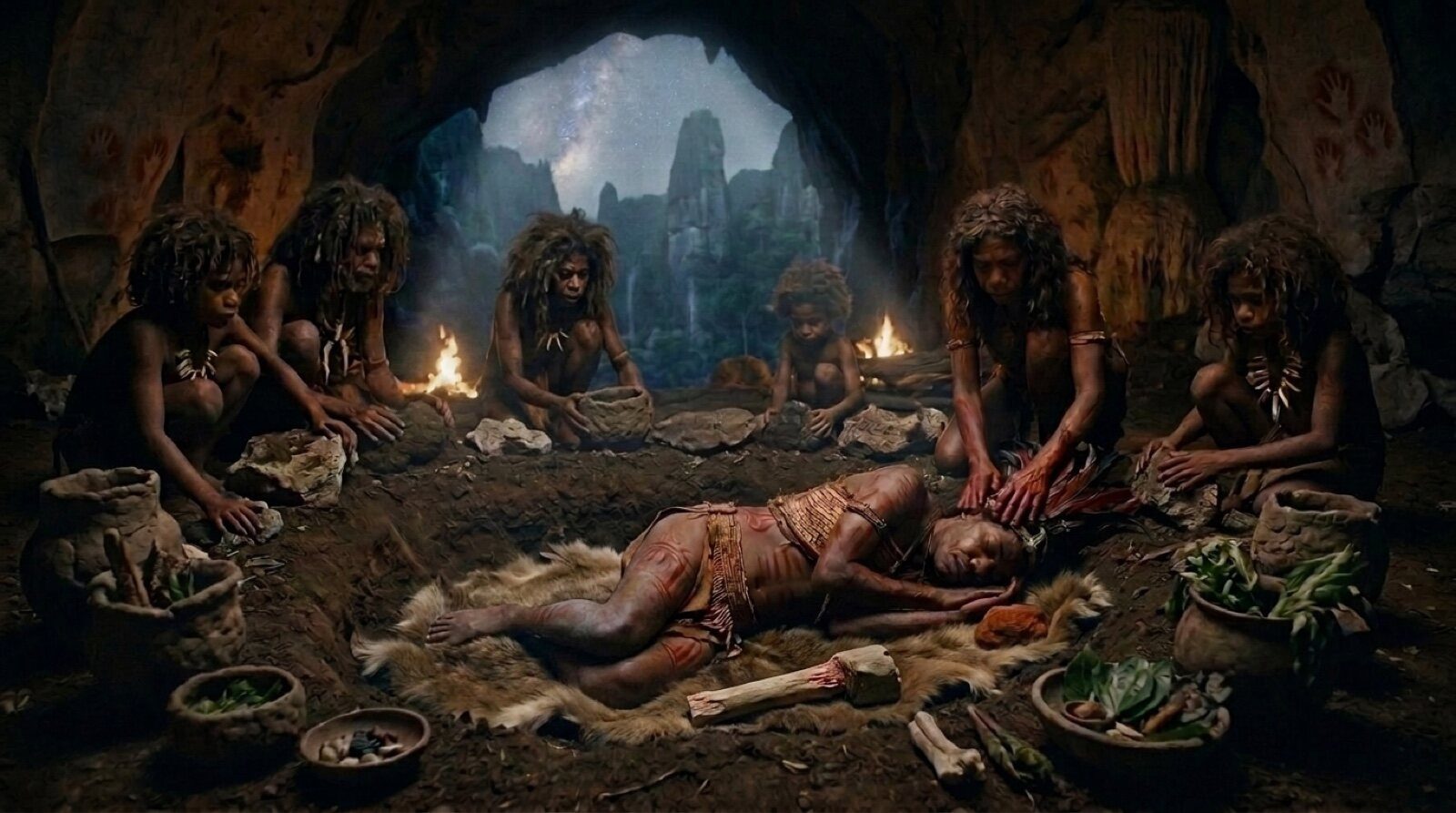
Tebo 1 dies around nineteen or twenty, nine to ten years on from the amputation survived as a child, having lived a life no one would have wagered on, made possible by the very community that survival helped create. Death comes quietly and without clear cause, unrelated to the long-healed leg, the ordinary arithmetic of a Pleistocene lifespan, where to reach this age was already to have lived a full life. Tebo 1's people cut a grave into the cave floor and fold the body into it, flexed with the right knee drawn to the chest, a nodule of red ochre placed by the jaw, flaked stone tools set alongside, hand stencils on the cave's walls and the Milky Way in its mouth. The burial itself, the flexed body, the ochre, the stone-tool grave goods, is read from the actual 2020 excavation at Liang Tebo, the oldest intentional primary burial of a modern human known from Island Southeast Asia, and the first sign of a belief that something endures.
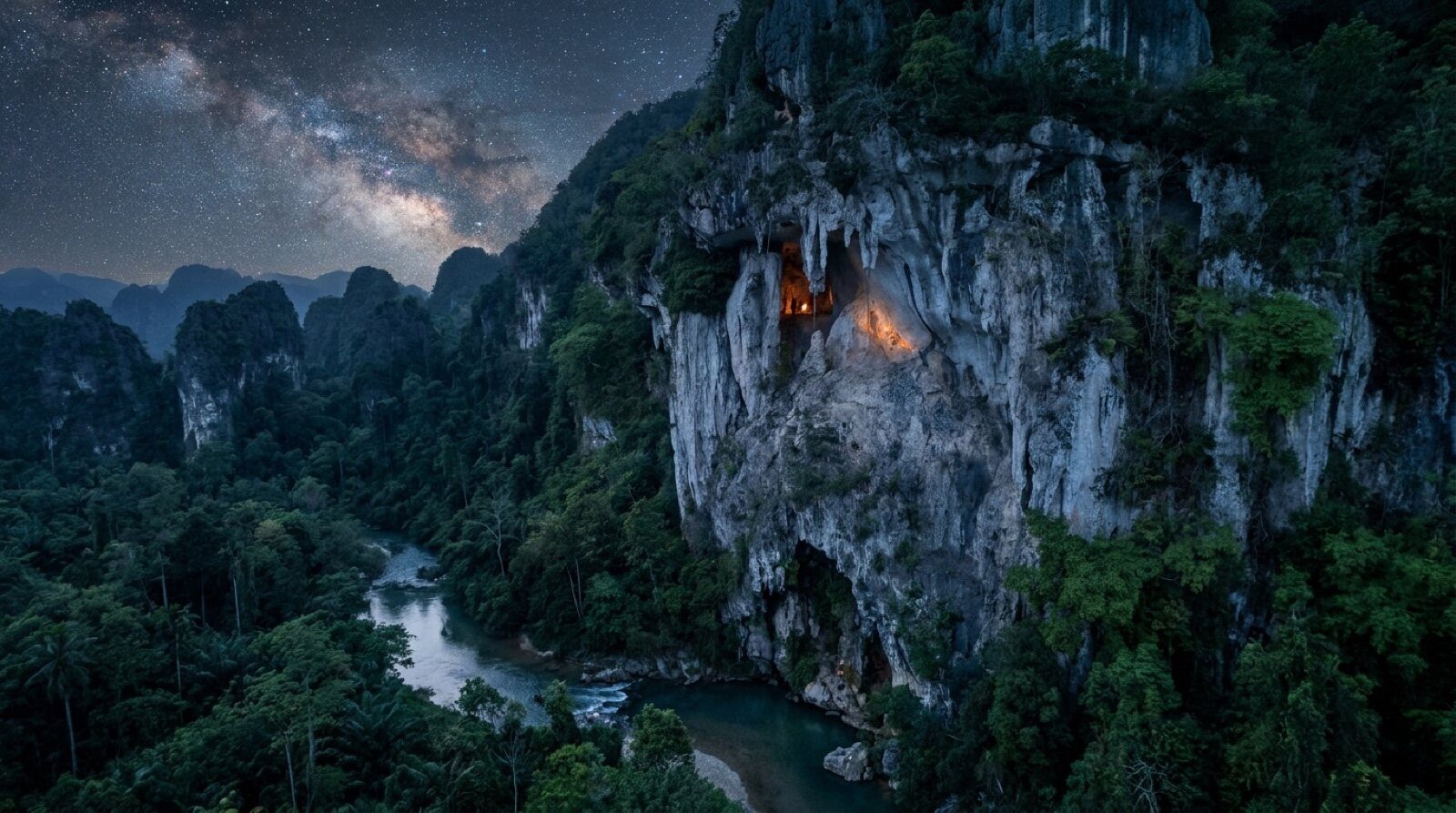
They laid Tebo 1 high in the cliff above the spring where the river is born, water rising out of rock into life. The awakening was not only to care for one another but to read the world as meaning: the cave a threshold, the spring a source, the stars a beyond. The first stirring of symbol and story that still shapes us.
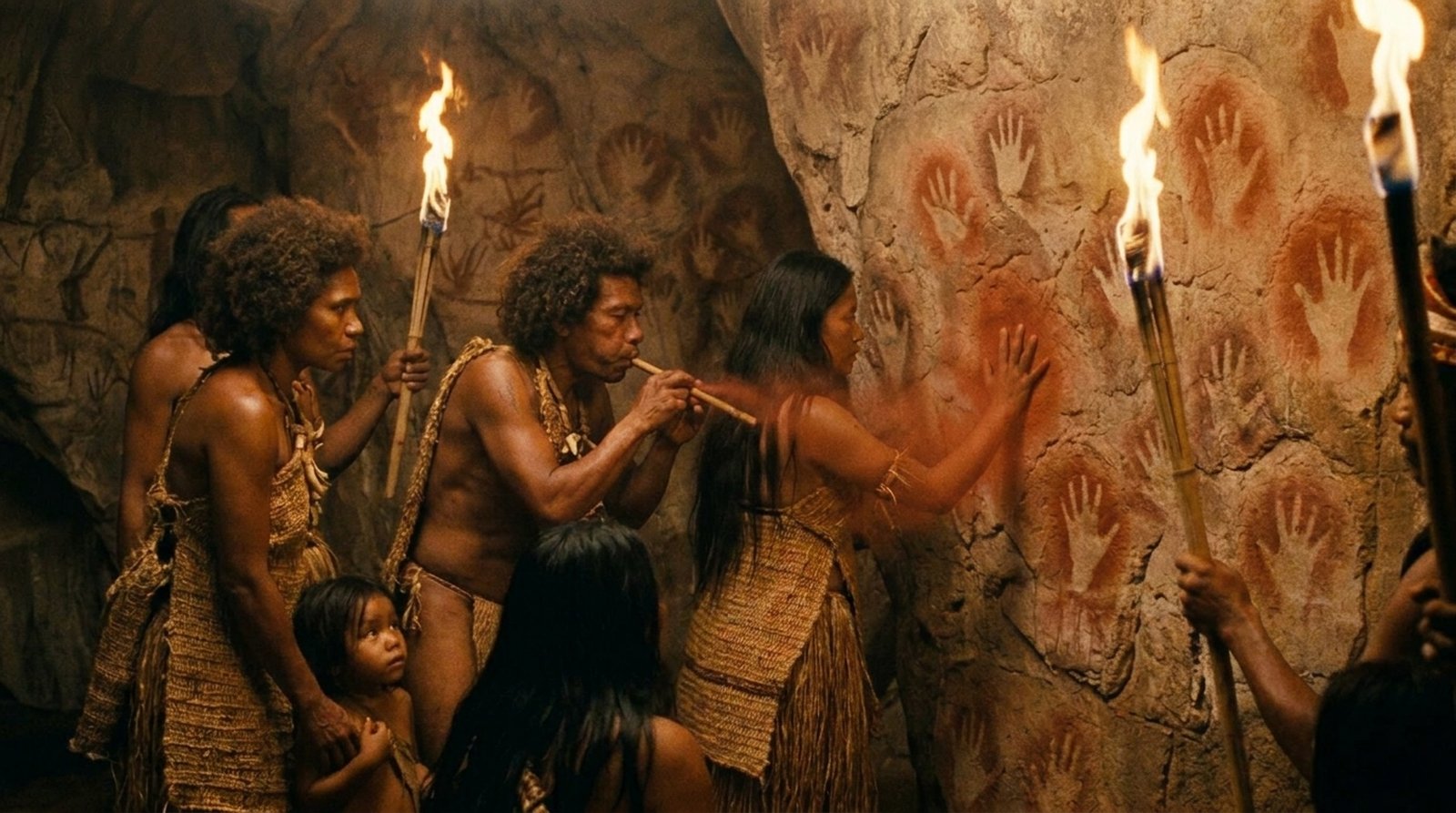
By torchlight, ochre is blown around hand after hand, a small one among them. The choice to carry the one who could not keep up is what made them a community. This is where 'us' begins, the bond that made us stronger than any instinct to leave.
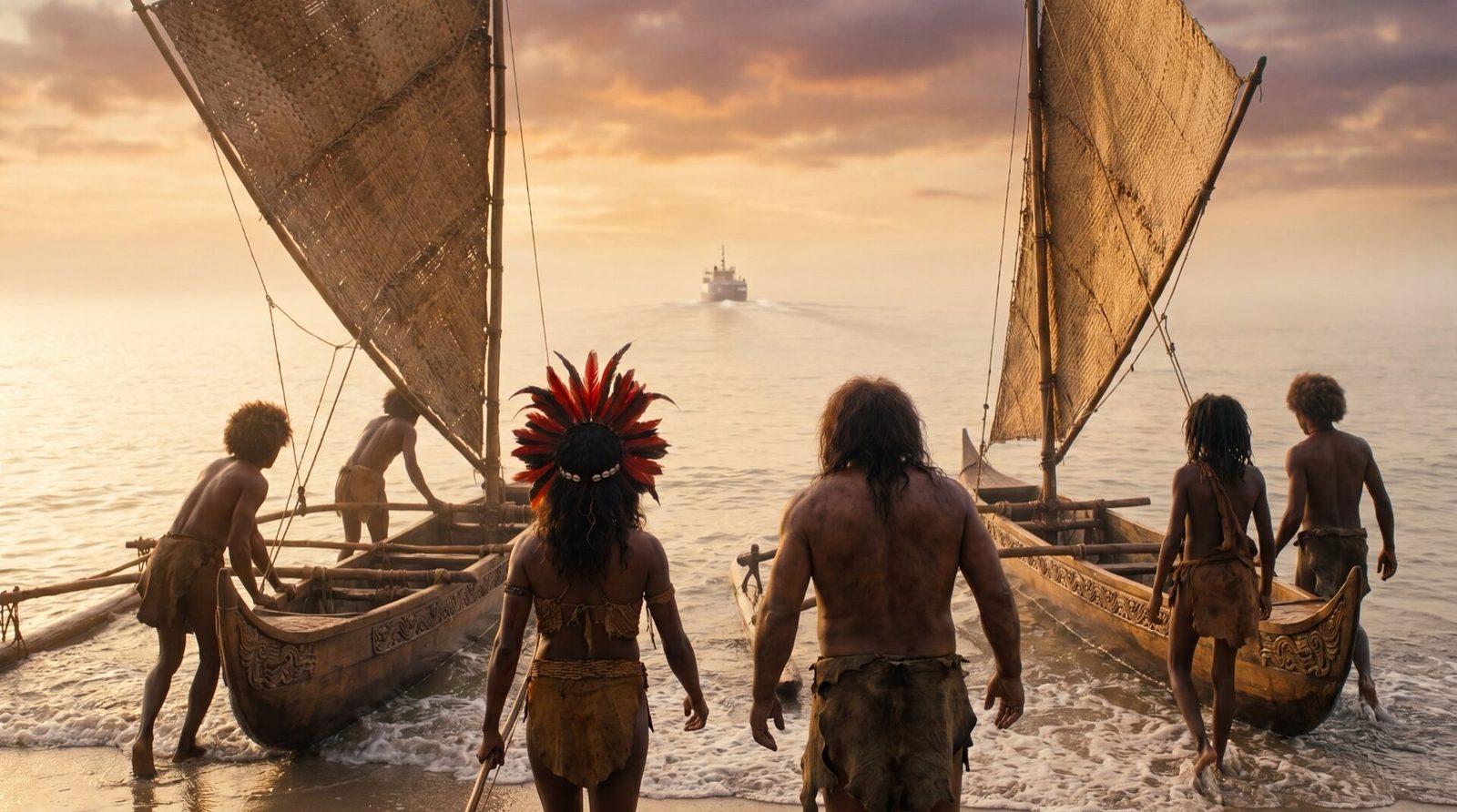
At the water's edge Tebo 1's people raise their sails and look out at a world without edges, the first wayfinders, ready to cross. Far on the horizon a small boat is already sailing, ours. Every portal before this looked back into them; this one looks forward, out of the deep past and into us. They didn't vanish. They became us.
Rotate to landscape for the full-screen, cinematic flip-through.